
Every parent of a neurodiverse child has witnessed those heartbreaking moments when their child's shoulders slump after another "failed" attempt at something that seems effortless for their peers. Whether it's struggling to tie their shoes while watching classmates sprint past them, or sitting quietly while other children share stories they can't quite organize in their minds, these moments can chip away at a child's sense of self-worth faster than we can rebuild it.
The cruel irony is that neurodiverse children often possess remarkable talents and perspectives that the world desperately needs, yet they frequently feel inadequate because traditional measures of success don't capture their unique brilliance. Parents find themselves caught in an exhausting cycle of trying app after app, program after program, searching for that magic solution that will help their child see themselves the way their families do, as capable, valuable, and worthy of celebration.
Here's the truth that might surprise you: the most powerful confidence-building tool for neurodiverse children doesn't require a single download, subscription, or special training. It's something you can implement right now, today, in the next conversation you have with your child.
The Power of Specific Praise: Why Your Words Are the Ultimate Confidence Tool
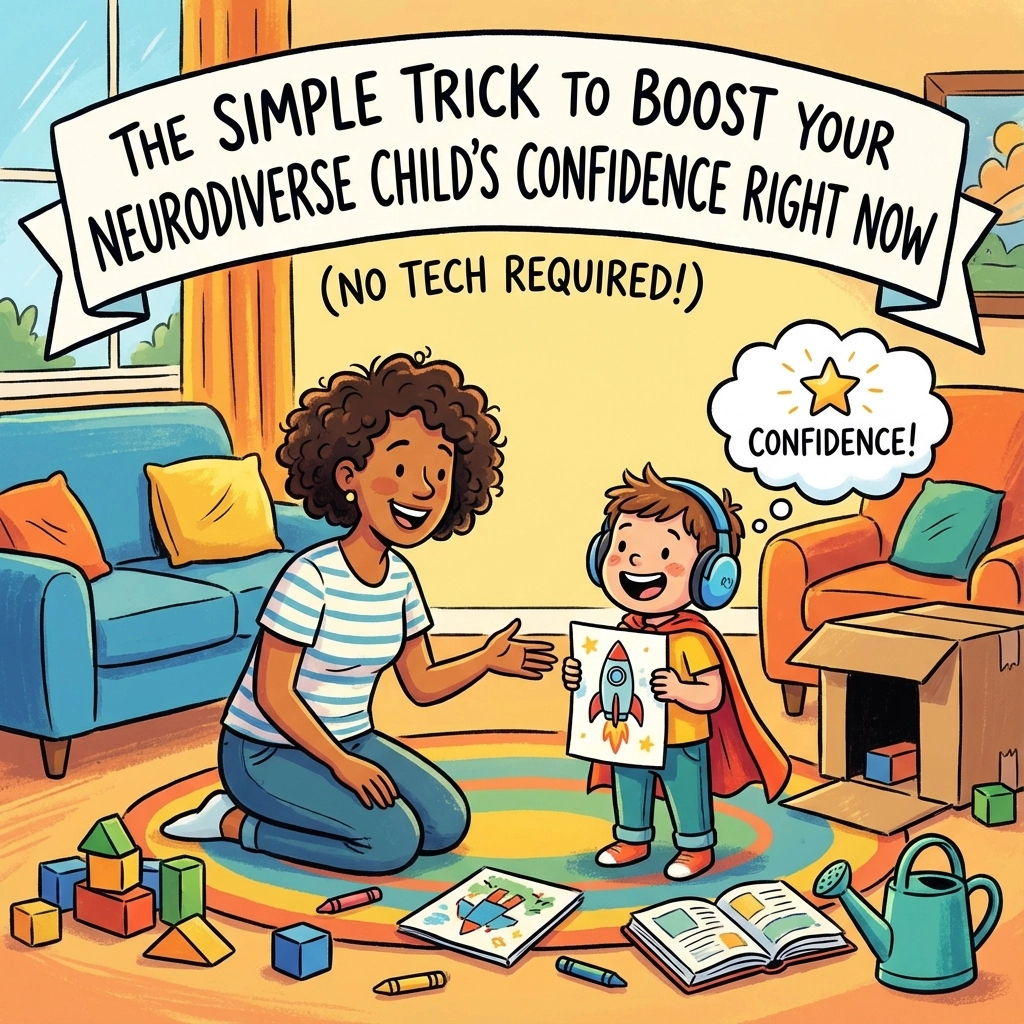
The simple trick that transforms confidence faster than any technology or therapeutic intervention is specific praise focused on effort and process rather than generic outcomes. Instead of saying "Good job!" when your child accomplishes something, describe exactly what they did well and why it matters.
"I noticed how you organized your backpack this morning, putting your heavy textbooks on the bottom and your fragile art project on top. That kind of planning shows real problem-solving skills."
"When you got frustrated with that math problem, I saw you take three deep breaths before trying a different approach. That's what resilience looks like."
This approach works because neurodiverse children often struggle with something researchers call "imposter syndrome in reverse", they become convinced that any success they experience must be a fluke rather than evidence of their capabilities. Generic praise like "You're so smart!" actually reinforces this feeling because it doesn't connect the success to their specific actions or efforts.
Dr. Sarah Martinez, a developmental psychologist who specializes in neurodevelopmental differences, explains: "When we offer specific feedback about the strategies and efforts our children use, we're teaching them to recognize their own competence. They begin to understand that their successes aren't accidents, they're the result of skills they can develop and deploy again."
Creating Your Child's Personal Victory Documentation System
The second component of this confidence-building approach involves making achievements visible and permanent through what families in our community call "victory documentation." This doesn't mean creating elaborate scrapbooks or digital portfolios, it means helping your child see patterns of success they might otherwise forget or dismiss.
The Weekly Wins Jar
Start with something as simple as colored paper strips in a mason jar. Every Sunday, sit down with your child and write down three things they accomplished that week on individual strips of paper. These don't need to be major milestones, they can be small moments like "remembered to feed the fish without being reminded" or "helped sister find her lost toy by thinking like a detective."
Sarah, mother of 8-year-old Marcus who has ADHD, shares: "We started the wins jar six months ago, and now Marcus asks every few days if we can read through some of the old ones. Last week he said, 'Mom, I didn't know I was good at so many things!' It's become this treasure chest of evidence that he's capable and growing."
The Effort Awards System
Create a simple visual display where your child can see recognition for specific efforts rather than just outcomes. This might be a bulletin board, a section of the refrigerator, or even a special notebook. The key is celebrating the processes that lead to success: persistence, creativity, problem-solving, kindness, or any other strength you observe.
Why This Approach Succeeds Where Technology Often Fails
Many parents turn to apps and digital tools hoping to gamify confidence-building, but these solutions often miss the mark for neurodiverse children because they focus on external validation rather than internal recognition. A child might earn 100 digital badges but still feel fundamentally flawed because the praise doesn't connect to their authentic self-experience.

The Xtermigator character teaches children that different abilities aren't disabilities, they're superpowers waiting to be recognized and celebrated.
The victory documentation approach works because it helps children develop what psychologists call "attribution theory", the ability to correctly connect their efforts and strategies to positive outcomes. When children understand that their successes stem from specific actions they took, they develop confidence that they can recreate those successes in new situations.
Real-World Implementation: The 48-Hour Confidence Boost
Tomorrow morning, try this immediate intervention:
- Observe without judgment for the first two hours of your child's day
- Identify one specific effort they make (not the outcome, but the process)
- Describe what you saw using concrete, behavioral language
- Connect it to a character strength they demonstrated
Example: "When you realized your math homework was still in your locker, I watched you problem-solve by calling Tyler to see if you could borrow his textbook. That shows real resourcefulness and friendship skills."
Advanced Confidence-Building Techniques: The Strengths Inventory Method
Once your child becomes comfortable with specific praise and victory documentation, you can introduce more sophisticated confidence-building strategies. The strengths inventory method involves helping your child identify their unique cognitive and emotional assets, the specific ways their brain works that create advantages in certain situations.
Mapping Neurodivergent Superpowers
Work with your child to create a "superpowers map" that identifies their unique neurological gifts. A child with ADHD might recognize their ability to hyperfocus on interesting topics, make creative connections others miss, or provide high energy that motivates group projects. A child with autism might celebrate their attention to detail, logical thinking patterns, or deep expertise in their special interests.
Tom, father of 12-year-old Elena who has autism, explains: "We spent one afternoon listing all the ways Elena's brain works differently, and instead of seeing them as problems to fix, we looked for the advantages. Her need for routine became 'reliability superpowers.' Her intense focus on marine biology became 'expertise superpowers.' Now when kids tease her about being different, she says, 'Yeah, my brain has special features.'"

In the Friendly Ferns Swamp, every character's differences contribute to the community's strength: just like in real families where neurodiversity creates unique advantages.
Addressing the Perfectionism Trap: Teaching "Good Enough" Excellence
Many neurodiverse children develop perfectionism as a coping mechanism: if they can't do something perfectly, they'd rather not try at all. The specific praise approach helps address this by celebrating incremental progress and effort-based achievements rather than flawless outcomes.
The 80% Celebration Rule
Implement a family rule that 80% effort deserves 100% celebration. When your child completes a project that isn't perfect but represents genuine effort, celebrate it as enthusiastically as you would a perfect performance. This teaches them that growth and engagement matter more than flawless execution.
Process-Based Success Stories
Share stories from your own life where imperfect efforts led to meaningful outcomes. Help your child understand that most real-world successes come from persistence, adaptation, and learning from mistakes rather than getting everything right the first time.
Building Long-Term Confidence: The Identity Shift Strategy
The ultimate goal of specific praise and victory documentation isn't just to make children feel good in the moment: it's to help them develop a fundamental identity shift from "I'm the kid who struggles" to "I'm the kid who finds creative solutions" or "I'm the kid who cares deeply about things that matter."
This identity shift happens gradually as children accumulate evidence of their capabilities and begin to see patterns in their successes. The victories jar becomes proof that they're competent. The specific praise teaches them to recognize their own problem-solving strategies. The strengths inventory helps them understand that their neurological differences create advantages, not just challenges.
Creating Future-Focused Confidence
Help your child connect their current strengths to future possibilities. A child who shows exceptional pattern recognition might learn about careers in data analysis, music composition, or scientific research. A child with high empathy and social awareness might explore futures in counseling, education, or community organizing.
The simple trick of specific praise becomes a foundation for lifelong confidence when children begin to see themselves as people with unique gifts that the world needs. In a society that often focuses on fixing deficits, this approach celebrates the extraordinary potential that lies within neurological difference.
Every time you notice your child's effort and name it specifically, you're not just boosting their confidence for that moment: you're teaching them to become their own best advocate, their own source of motivation, and their own evidence that different is not less than; different is beautiful.