
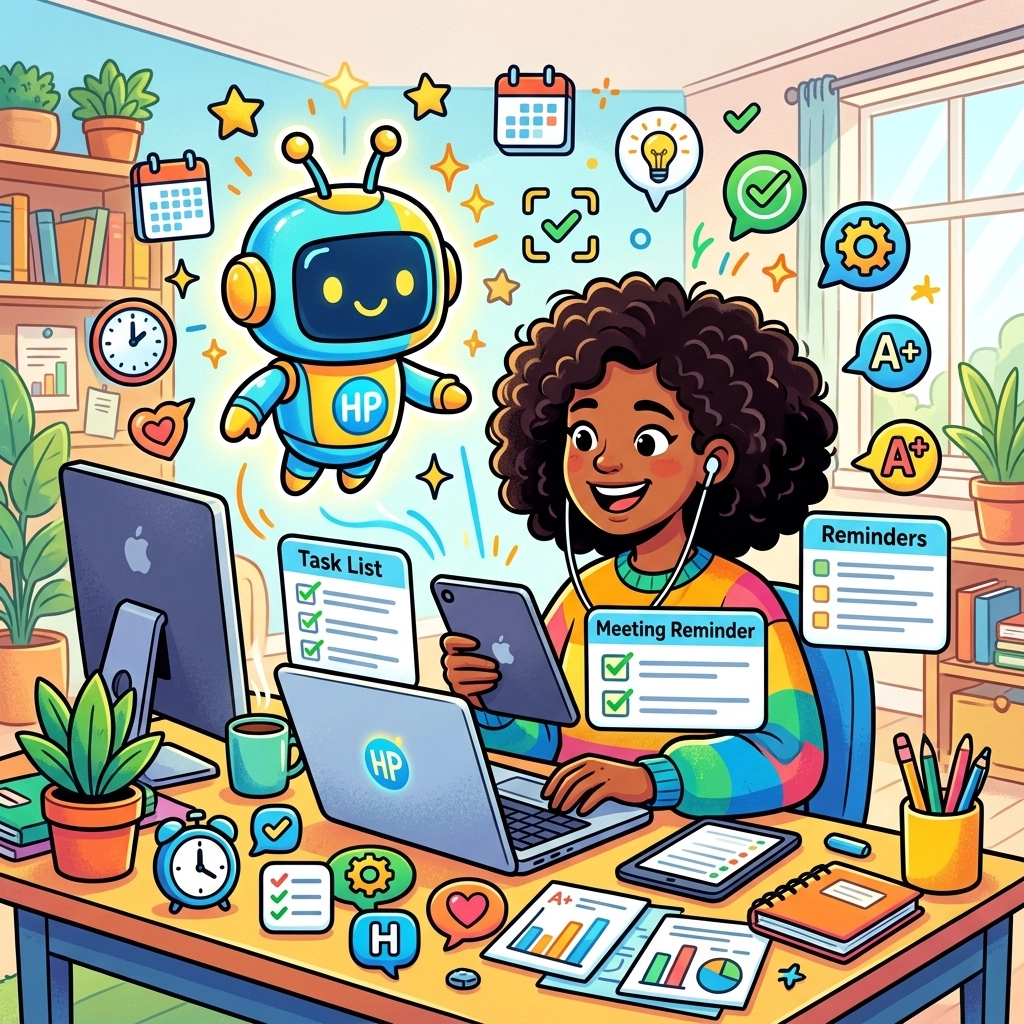
You know that feeling when your brain has forty-seven tabs open, three of them are playing music you can’t find, and your "To-Do" list looks more like a collection of vague threats than a plan? For many of us living with invisible disabilities, like ADHD, dyslexia, or chronic fatigue, the hurdle isn’t a lack of ideas or ambition. It’s the "Executive Function Wall." It’s that invisible barrier that makes starting a simple email feel like climbing Mount Everest in flip-flops.
Traditional productivity tools often make the problem worse. They demand more organization, more tagging, and more maintenance, which just adds to the cognitive load (the total amount of mental effort being used in the working memory). We don’t need more "work about work." We need a partner that can catch our thoughts before they float away. That’s where AI productivity tools, and specifically HeyPocket, are starting to change the game.
The Frictionless Path: Why Simplicity is an Accessibility Feature
When we talk about an AI note taking app, we’re usually talking about features. But for someone dealing with neurodivergence, "features" can often translate to "distractions." HeyPocket has taken a different route by focusing on three core pillars: Simplicity, Speed, and Flexibility.
In a recent review from the Dr Disruptor Network, a community dedicated to exploring how technology disrupts traditional barriers for the neurodivergent, one user noted:
"Most AI tools feel like I’m learning a new language just to tell it I need to buy milk. HeyPocket is the first tool I’ve used where the latency (the delay between thought and digital capture) is almost zero. It doesn’t ask me to categorize. It just listens and organizes. For my ADHD brain, that’s not just a feature, it’s a lifeline."
This sentiment is something we talk about a lot here at XTERMIGATOR KIDS. Whether you’re a parent trying to keep track of IEP meetings or a student struggling to differentiate between symptoms, the tool shouldn’t be the obstacle. If you've ever wondered about the root of your daily struggles, you might find our guide on Is It ADHD or Overstimulation? 7 Ways to Tell the Difference helpful in identifying those patterns.
Above: Finding clarity in the "Swamp" of daily tasks requires tools that simplify rather than complicate.
Real-World Use Cases: Beyond the To-Do List
What does "productivity" actually look like when you use an AI tool that adapts to you? It’s not just about checking boxes. It’s about building a secondary brain that handles the heavy lifting of structure.
1. XTERMIGATOR KIDS Content Creation
In our own offices, we’ve been putting HeyPocket through its paces. Eric and the team use it to bridge the gap between a "random spark of a character idea" and a full-blown story. When we’re developing the Friendly Ferns Swamp characters, we don’t always have the mental bandwidth to sit down and write a formal draft. We can vent our ideas into HeyPocket, and its AI capabilities help us structure those thoughts into the educational resources you see on our site today.
2. Academic Research and Deep Work
For students with invisible disabilities, academic research can be a nightmare of disconnected PDFs and half-finished citations. HeyPocket allows for a "flexible capture" method. You can dump raw data, voice notes, and snippets of text into the app, and let the AI find the connections. It helps users bypass the "blank page syndrome" by providing a synthesized summary of their own research.
3. App Building and Technical Projects
You might think an AI productivity tool is just for writers, but the Dr Disruptor AI tool reviews have highlighted its use in technical fields. When building apps or managing complex projects, the flexibility to "braindump" code logic or user flow ideas without worrying about formatting allows for a flow state that is usually interrupted by traditional project management software.
The Emotional Transformation: From "Lazy" to "Supported"
One of the most damaging aspects of living with an invisible disability is the internal narrative. When you can’t get organized, you start to call yourself "lazy" or "unmotivated." As we explore in "The Ultimate Guide to Invisible Disabilities: Lessons from the Friendly Ferns Swamp" over at Friendly Ferns writing resources, these labels are rarely true.

When a tool like HeyPocket takes over the role of "Administrative Assistant," an emotional shift happens. You aren't fighting your brain anymore; you're collaborating with a system.
"I used to spend three hours just trying to figure out where to start my day," shares a member of the Inclusive Game Day community. "Now, I just talk to HeyPocket while I'm making coffee. It sorts my rambles into a priority list. I don’t feel like I’m failing before 9:00 AM anymore."
This reduction in "task paralysis" (the inability to start a task due to being overwhelmed by its complexity) is the ultimate goal of tools for ADHD productivity. It’s about returning the user's agency.
Why We’re Partnering with HeyPocket
You guys know we don’t just recommend anything. We’re big on making sure the tools we talk about actually align with our mission of "A disability is not an inability." We are excited to announce that we’ve officially become an affiliate for HeyPocket.
Why? Because it fits the XTERMIGATOR KIDS ethos. It’s inclusive, it’s educational in how it helps you understand your own thought patterns, and it’s fast. If you want to check it out and support our community at the same time, you can find it here: Try HeyPocket for yourself.
The right tools allow us to focus on what matters most: kindness, growth, and community connection.
Invisible Disabilities and Technology: The Road Ahead
We are entering an era where technology is finally moving away from "one size fits all." For years, we were expected to adapt our brains to fit the software. Now, the software is finally adapting to fit our brains.
Whether it's AI note taking apps like HeyPocket or more specialized tools discussed in Dr Disruptor AI tool reviews, the focus is shifting toward accessibility-first design. This means:
- Voice-to-Text that understands context, not just grammar.
- Automatic Summarization that cuts through the noise of long documents.
- Low-Barrier Entry so you don't need a tutorial to start being productive.
As we continue to build out the Inclusive Game Day accessibility discussions, we see AI playing a massive role in how we level the playing field for kids and adults alike.
Final Thoughts: Give Yourself Grace
At the end of the day, no tool is a magic wand. There will still be days when the brain fog is thick and the motivation is low. But having a tool like HeyPocket in your back pocket (literally) means you have a safety net.
If you’re tired of the "planner guilt" and looking for a way to manage your invisible disability with a bit more ease, give AI tools a shot. Start small. Capture one thought. Let the AI handle the rest. You might find that you weren't "broken" or "lazy" after all: you just needed a different kind of pocket for your thoughts.
We’re excited to see where this technology goes. Imagine a world where every student with dyslexia has an AI co-pilot, or every adult with ADHD has a seamless way to track their brilliant but fleeting ideas. That’s the world we’re working toward at XTERMIGATOR KIDS.
Keep moving forward, keep being kind to yourself, and remember: different is beautiful, and with the right tools, you are unstoppable.
Got questions about how we use HeyPocket or other AI tools? Drop a comment in our Community Connection or check out our latest FAQ for more resources on navigating invisible disabilities.