
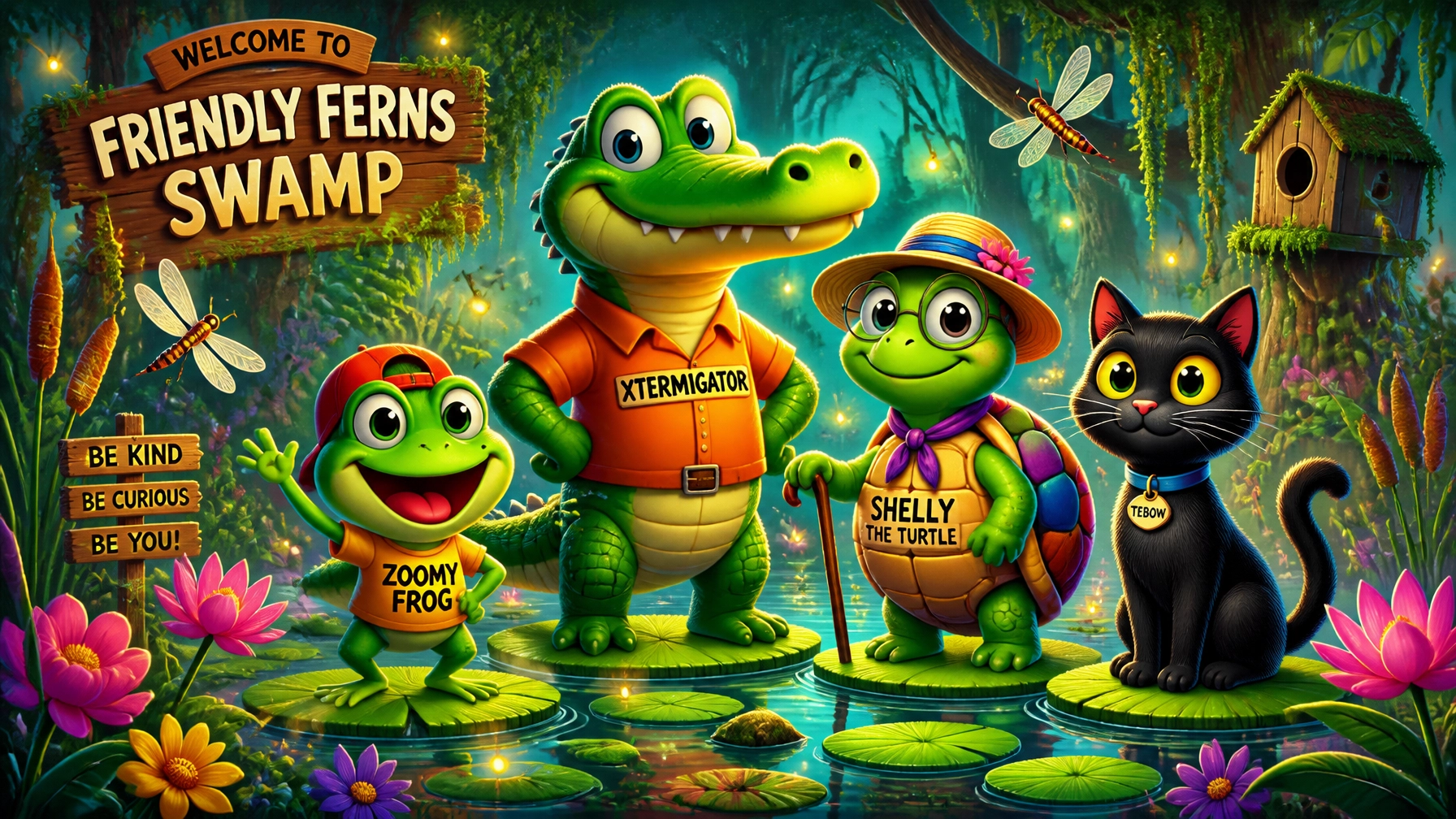
You’re standing in the middle of the "Swamp of Uncertainty," and the fog is thick. One moment, your child is bouncing off the walls like a runaway pinball; the next, they’re having a complete meltdown because the tag on their shirt feels like a swarm of angry bees. You’ve spent late nights staring at the ceiling, scrolling through forums, and wondering: Is this ADHD? Is it Anxiety? Could it be Autism? Or is it a bit of everything?
Identifying these invisible disabilities can feel like trying to map the shifting currents of the Friendly Ferns Swamp. The symptoms often overlap, camouflage, and mimic one another, leaving parents and educators feeling overwhelmed. As one mother, Sarah, shared during a recent Community Connection workshop: "I spent three years thinking my son was just 'anxious' about school, only to realize his brain was actually processing sensory information at a completely different frequency. We were treating the smoke, but we hadn't found the fire."
At XTERMIGATOR KIDS, we believe that understanding these differences shouldn't require a medical degree and a magnifying glass. By looking at our friends in the Friendly Ferns Swamp, we can begin to see that these aren't just "deficits": they are different ways of experiencing the world. As we always say, a disability is not an inability; it’s your greatest superpower.
Zoomy Frog and the Quest for Constant Motion (ADHD)

If you’ve ever met Zoomy Frog, you know he doesn’t just walk: he boings. Zoomy represents ADHD (Attention-Deficit/Hyperactivity Disorder), a condition primarily centered around the regulation of attention, activity levels, and impulsivity.
For Zoomy, the swamp is a buffet of distractions. A dragonfly zips past? He’s after it. A ripple in the water? He’s diving in. A shiny pebble? He’s forgotten the dragonfly entirely. This isn't because Zoomy doesn't want to listen; it's because his internal "filter" (the executive function that helps the brain prioritize tasks) is set to "Everything is Important All at Once."
Technical Note: Executive functions are the mental processes that enable us to plan, focus attention, remember instructions, and juggle multiple tasks successfully.
"People often think ADHD is just about being 'hyper,'" explains Dr. Aris Thorne, a developmental specialist who frequently consults on our educational resources. "But for a child like Zoomy Frog, it’s actually an 'interest-based nervous system.' They can hyper-focus for hours on something they love: like building the perfect lily pad fort: but struggle immensely with 'boring' tasks like cleaning their swamp-den."
What parents might notice:
- Starting many projects but rarely finishing one (the "half-built fort" syndrome).
- Acting without thinking (impulsivity), like jumping into deep water before checking the depth.
- A brain that feels like a Ferrari engine with bicycle brakes.
Shelly the Turtle and the Comfort of the Known (Autism)

While Zoomy is zig-zagging, Shelly the Turtle is likely sitting on her favorite mossy log, carefully arranging her collection of smooth river stones by size and color. Shelly represents traits often seen in Autism (Autism Spectrum Disorder), where the world is experienced through the lenses of social communication differences, sensory processing, and a deep love for routine.
For Shelly, the swamp can sometimes feel too loud, too bright, or just too much. She finds safety in the predictable. If the sun rises in the east and her stones are in a perfect row, the world feels "right."
Contextual Note: Sensory processing refers to how the brain receives and responds to information that comes in through the senses: sound, touch, sight, etc. For many on the spectrum, these inputs can be turned up to an 11.
"Autism is about how a person interacts with the social world and processes their environment," notes Eric Fishon, founder of XTERMIGATOR KIDS. "Shelly might not always make eye contact when she’s talking to Xtermigator, but that doesn’t mean she isn’t listening. She’s just focusing her energy on the words rather than the 'social dance' of looking at faces."
What parents might notice:
- A strong need for routine (getting upset if the route to school changes).
- Intense, specialized interests (knowing every single type of swamp moss).
- Differences in social communication (taking things literally or preferring to play alongside peers rather than with them).
Tebow the Cat and the Watchful Night-Eyes (Anxiety)

Then there is Tebow the Cat. Tebow is loyal, cool, and incredibly observant. But sometimes, those big eyes see things the others don't: not because they are there, but because Tebow’s brain is a world-class "danger detector." Tebow represents Anxiety, a condition where the brain’s "alarm system" (the amygdala) is essentially stuck in the 'On' position.
Anxiety can look a lot like ADHD or Autism, which is why it’s the ultimate swamp-mimic. A child might refuse to go to a birthday party. Is it because they are overstimulated by the noise (Autism)? Or is it because they are terrified that something bad might happen (Anxiety)?
"Anxiety is 'what if' thinking," says Maria, a school counselor and regular contributor to our Swamp Talk forum. "Tebow might ask the same question ten times: 'Are you sure the alligator is friendly?': not because he forgot the answer, but because his brain needs that constant reassurance to quiet the alarm."
Technical Note: Hyper-vigilance is an enhanced state of sensory sensitivity accompanied by an exaggerated intensity of behaviors whose purpose is to detect threats.
What parents might notice:
- Frequent physical complaints, like "tummy aches" before school.
- Asking for constant reassurance ("Are you sure? Do you promise?").
- Avoiding specific situations or "freezing" when faced with something new.
The Great Swamp Overlap: When Traits Collide

Here is where it gets tricky: in the real world, these conditions rarely travel alone. In fact, research shows that 40–60% of autistic children also have ADHD or Anxiety. This is what we call "comorbidity" (the presence of one or more additional conditions co-occurring with a primary condition).
Imagine Zoomy Frog trying to catch dragonflies while also being worried about the shadows in the reeds, and also being bothered by the itchy feel of the water lilies. That’s a lot for one little frog to handle!
Photo Caption: In our book "Xtermigator & The Zoomy Frog," we explore how Xtermigator uses his detective skills to help his friends navigate these complex feelings.
When we stop looking at these as "disorders to be fixed" and start seeing them as "traits to be managed," the transformation is incredible. We’ve seen children who were labeled "difficult" become the most creative problem-solvers in their classrooms once their ADHD was channeled into a "superpower" of hyper-focus and energy. We’ve seen "anxious" children become the most empathetic leaders because they are so attuned to the feelings of others.
Moving Forward: From Labels to Empowerment
So, how do we navigate this as a community?
- Stay Curious, Not Judgmental: Instead of asking "Why is my child acting out?", ask "What is my child’s behavior trying to tell me?"
- Use the Right Tools: Whether it’s a Cozyla Digital Calendar to help with Shelly’s need for routine or our personalized tutoring sessions to help Zoomy find his focus, the right support makes all the difference.
- Celebrate the Superpower: Every character in the Friendly Ferns Swamp brings something unique to the table. Xtermigator’s leadership, Zoomy’s energy, Shelly’s precision, and Tebow’s observation: together, they are unstoppable.
As we look toward the future, our goal at XTERMIGATOR KIDS is to provide even more resources, from new books in the Friendly Ferns series to interactive workshops that bridge the gap between "diagnosis" and "discovery." We want every child to walk out of their home feeling like a hero in their own story.
The swamp might be foggy sometimes, but with a little understanding, a lot of kindness, and the right friends by your side, it’s also a place of incredible magic.
If you’re looking for more ways to support your child's unique brain, check out our FAQ page or join the conversation in our Community Forum.