
For many families, the most challenging battles aren't the ones you can see; they are the ones happening beneath the surface. When a child struggles to sit still, becomes overwhelmed by a flickering light, or freezes in the face of a new social situation, it isn't "bad behavior." It is a manifestation of an invisible disability: a term used to describe physical, mental, or neurological conditions that are not immediately apparent to others.
“The hardest part for my son isn't the ADHD itself,” says Sarah Jenkins, a mother of a seven-year-old and long-time reader of the Xtermigator Kids series. “It’s the constant feeling that he’s failing at things that seem easy for everyone else. People see a kid who won't listen, but I see a kid whose brain is a Ferrari with bicycle brakes.”
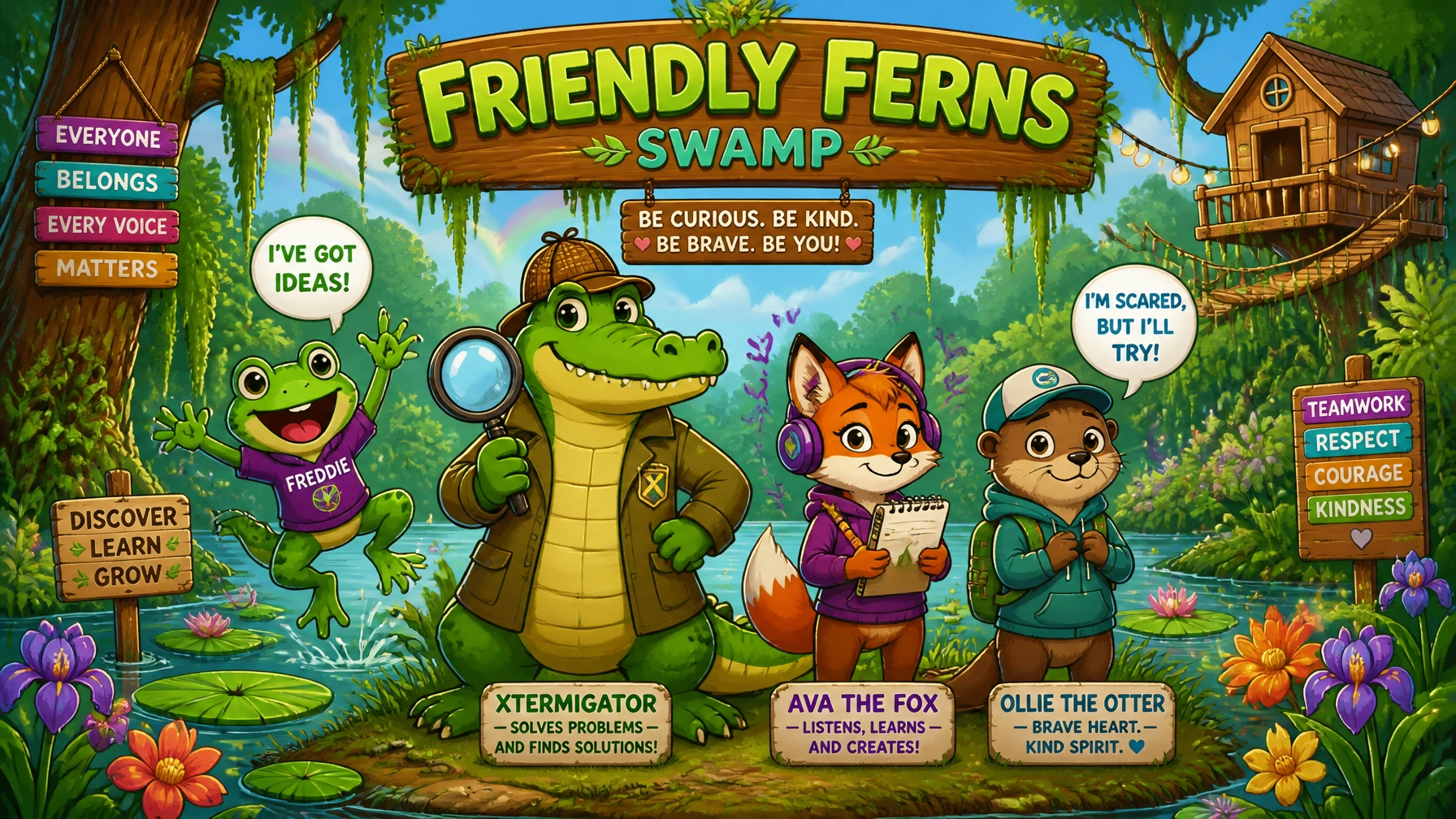
At XTERMIGATOR KIDS, we believe that understanding is the first step toward true inclusion. By transforming these complex neurological realities into the whimsical adventures of the Friendly Ferns Swamp, we help children and adults alike see that a disability is not an inability: it’s your greatest superpower.
Harnessing High Energy through Freddie’s "Zoomies"
Freddie the Frog is the heart and soul of the swamp’s high-energy activities. He has what he calls "the Zoomies" (a relatable term for ADHD or Attention Deficit Hyperactivity Disorder). To an outsider, Freddie might look like he’s just easily distracted or unable to stay on a single lily pad. But Xtermigator, our resident Inspector and Detective, knows better.

Freddie’s "Zoomies" are the engine behind some of the swamp’s most creative inventions.
“Freddie doesn’t just jump; he explores a hundred ideas at once,” notes Dr. Elena Rodriguez, a pediatric specialist in neurodevelopment. “When we frame ADHD as a creativity engine rather than a deficit of attention, we change the child’s self-narrative from ‘I’m a problem’ to ‘I’m an innovator.’”
In the swamp, Freddie the Frog uses his superpower of enthusiasm to lead the team during the Swamp Treasure Hunt. While others might get stuck on one path, Freddie’s brain jumps between possibilities, finding shortcuts and hidden gems that others miss. For educators, the lesson is clear: provide outlets for movement and celebrate the "out-of-the-box" thinking that comes with a fast-moving mind.
Creating Calm and Structure with Ava’s Attention to Detail
While Freddie is all about movement, Ava the Fox represents the beauty of a brain that thrives on routine and deep focus (traits often associated with Autism Spectrum Disorder, or ASD). Ava loves her noise-canceling headphones because the swamp can sometimes get a little too loud. She prefers knowing exactly what will happen next, and she finds deep comfort in the patterns of the ferns.

Ava reminds us that the world is full of intricate details if we just take the time to look.
“Ava taught my classroom that ‘different’ doesn’t mean ‘lesser,’” shares Mr. Thomas, a second-grade teacher. “We started using visual schedules and quiet zones, much like Ava’s favorite mossy corner. Suddenly, my students who used to melt down during transitions felt safe. They realized that needing a routine is a way to respect your own brain’s needs.”
Ava’s superpower is her incredible attention to detail. She can spot the smallest change in the swamp’s ecosystem (the complex network of living organisms and their environment). This deep focus allows her to solve problems that require precision. By honoring her need for predictability, the swamp community ensures Ava can bring her full brilliance to the group.
Finding Courage in the Face of Anxiety with Ollie the Otter
Anxiety can feel like a heavy fog, making the simplest tasks: like stepping into the water: feel impossible. Ollie the Otter is afraid of the water and gets nervous about loud noises or meeting new friends. In a world that often tells us to "just get over it," Ollie’s journey is one of incremental progress (the process of taking small, manageable steps toward a goal).

Courage isn't the absence of fear; it's Ollie taking one small step forward despite it.
“People think an otter should love water, and people think kids should love birthday parties or school assemblies,” says clinical psychologist Dr. Aris Thorne. “But for a child with an invisible disability like an anxiety disorder, those situations can be physically overwhelming. Ollie shows kids that it’s okay to be scared and that bravery is found in the 'one step at a time' approach.”
In the swamp, Xtermigator never pushes Ollie into the deep end. Instead, they celebrate every time Ollie touches the water’s edge with a paw. This inclusive approach fosters a sense of belonging, showing that courage is a superpower that grows the more you use it.
The Quiet Strength of Empathy and Patience
Inclusion isn't just about supporting those with high energy or intense focus; it’s also about valuing the quiet contributors. Shelly the Turtle deals with chronic fatigue (a condition where a person feels tired even after resting). She might not be the first to finish a race, but her superpower is patience. She notices the small, beautiful things that everyone else rushes past.
Beside her is Romeo the Cat, the swamp’s deep listener. Romeo doesn’t say much, but he has the superpower of emotional presence (the ability to be fully aware and supportive of another person’s feelings). When Freddie is too fast or Ollie is too scared, Romeo is there to simply "be."
“We often overlook the 'quiet' disabilities,” notes a community workshop leader from our inclusion programs. “But Shelly and Romeo remind us that resting is productive and listening is a form of action. They are the glue that holds the Friendly Ferns Swamp together.”
Practical Strategies for Inclusive Environments
Building a world: or a classroom: where neurodiversity (the concept that neurological differences are natural variations of the human genome) is celebrated requires intentionality. Here are a few ways to bring the spirit of the Friendly Ferns Swamp into your daily life:
- Normalize "Helper Tools": Just like Ava has her headphones and Ollie has his bravery pebble, encourage the use of fidgets, weighted blankets, or timers as standard tools for success.
- Use Storytelling to Build Empathy: Share stories like Xtermigator & the Zoomy Frog to give children a vocabulary for their feelings.
- Celebrate the "Why" Behind the "What": When a child struggles, be a detective like Xtermigator. Ask, "What is this behavior telling me about their needs?" instead of "How do I stop this behavior?"
- Implement Visual Supports: Use tools like the Cozyla Digital Calendar to help children navigate their day with less anxiety.
- Foster a Strengths-Based Mindset: Shift the focus from what a child can't do to what they can do. If they have high energy, they are your "idea engine." If they are quiet, they are your "observation expert."
A Future Where Every Superhero is Seen
As we look toward the future of the Friendly Ferns Swamp, our hope is that no child ever feels like their invisible disability is a secret they have to hide. We envision a world where "masking" (the exhausting process of hiding neurodivergent traits to fit into a neurotypical world) is no longer necessary because every environment is built for inclusion.
“My dream is for my daughter to walk into her classroom and feel as understood as Ava the Fox does in the swamp,” says Sarah Jenkins. “I want her to know that her deep focus isn't a quirk: it's her greatest strength.”
By sharing these stories and providing comprehensive resources, we are building that world together. We are teaching a generation of kids that whether they jump, crawl, hide, or watch, they have a place at the table: or on the lily pad.
Remember, in the Friendly Ferns Swamp and in life, your difference is your superpower. Let's keep exploring, keep learning, and keep being kind, brave, and uniquely ourselves.