
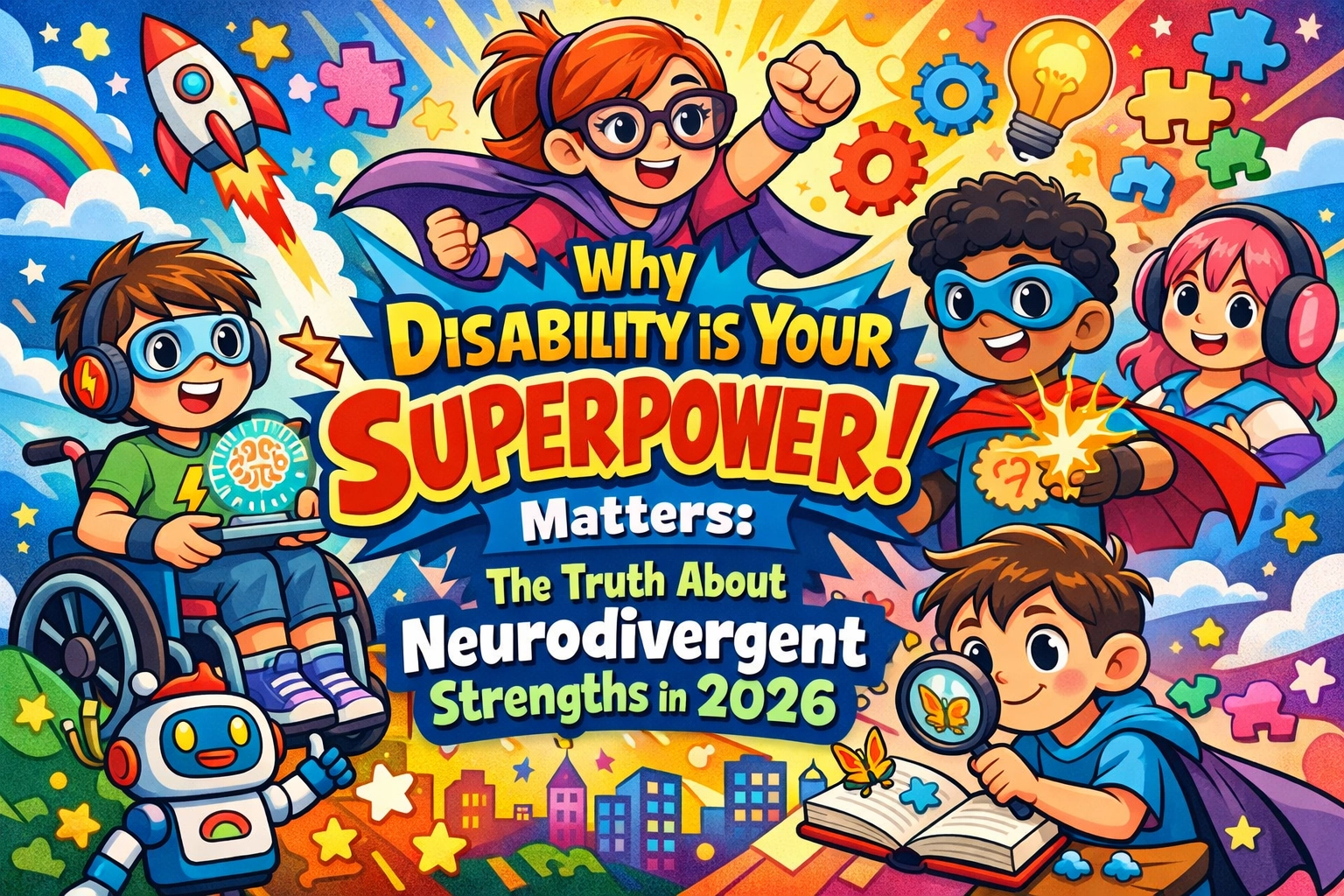
You've probably seen the T-shirts, the motivational posters, the Instagram graphics: "Disability is your superpower!" And if you're like most parents or educators of neurodivergent kids, you've probably had… complicated feelings about it.
Maybe you loved the positive spin at first. Then your child melted down in the grocery store for the third time that week, and you thought, This doesn't feel very super. Or maybe you're the adult who grew up being told you were "gifted" while secretly drowning in executive function challenges, and now this phrase feels like just another way to minimize real struggles.
Here's the thing: In 2026, we're finally having more nuanced conversations about neurodivergent strengths, conversations that acknowledge both the very real challenges and the genuine abilities that come with different brain wiring. And it turns out, when we get this framing right, it matters more than you might think.
What the "Superpower" Frame Gets Right (And Why It's Not Just Toxic Positivity)
Let's start with why this phrase gained traction in the first place. For generations, disability discourse centered almost exclusively on deficits. Medical models focused on what was "wrong," what needed to be "fixed," what made someone "less than." Kids grew up internalizing that their brains were broken.
The superpower framing emerged from disability justice movements (particularly gaining momentum in the 2010s and 2020s) as a direct counter-narrative. It wasn't about denying struggle, it was about refusing to accept that disability equals inferiority.
"When my daughter first heard the phrase 'your ADHD is your superpower,' something shifted," shares Marcus Chen, an educator from Portland. "She'd spent years feeling ashamed of her hyperfocus and rapid topic-switching. But reframing those traits as strengths, her ability to become an expert on topics she loved, her creative connections between ideas, gave her permission to see herself differently."

The Friendly Ferns Swamp celebrates that different is beautiful, and that together, we're unstoppable
That permission matters. Research from the Neurodiversity Institute (2025) found that neurodivergent young adults who identified at least three personal strengths related to their neurotype showed significantly higher self-advocacy skills and reported better mental health outcomes than those who viewed their differences purely through a deficit lens.
Where the Framing Can Go Wrong (And How to Avoid These Pitfalls)
But here's where we need to pump the brakes. The superpower framing can become problematic when:
It minimizes legitimate struggles. Saying "your autism is your superpower!" to a non-speaking autistic child who's overwhelmed by sensory input isn't empowering, it's dismissive. Real superpowers don't come with debilitating side effects.
It creates pressure to be exceptional. Not every neurodivergent person needs to be the next Temple Grandin or Greta Thunberg. Your dyslexic kid doesn't have to become a famous entrepreneur to justify their worth. Sometimes your superpower is just… being yourself and finding ways to navigate the world.
It shifts responsibility onto disabled people. When we focus only on superpowers, we can forget that much of disability is created by environments that weren't built with neurodivergent people in mind. The problem isn't that your kid can't sit still for eight hours, it's that we designed schools where everyone has to sit still for eight hours.
As disability advocate Lydia X. Z. Brown notes in their 2025 writing, "Celebrating neurodivergent strengths shouldn't mean abandoning the fight for accessibility and accommodation. We can acknowledge real abilities while still demanding that systems change."
The Real Neurodivergent Strengths We're Seeing in 2026
So what does a more honest, helpful strengths-based approach look like? It starts with recognizing actual patterns that research and lived experience have identified, not myths or stereotypes.
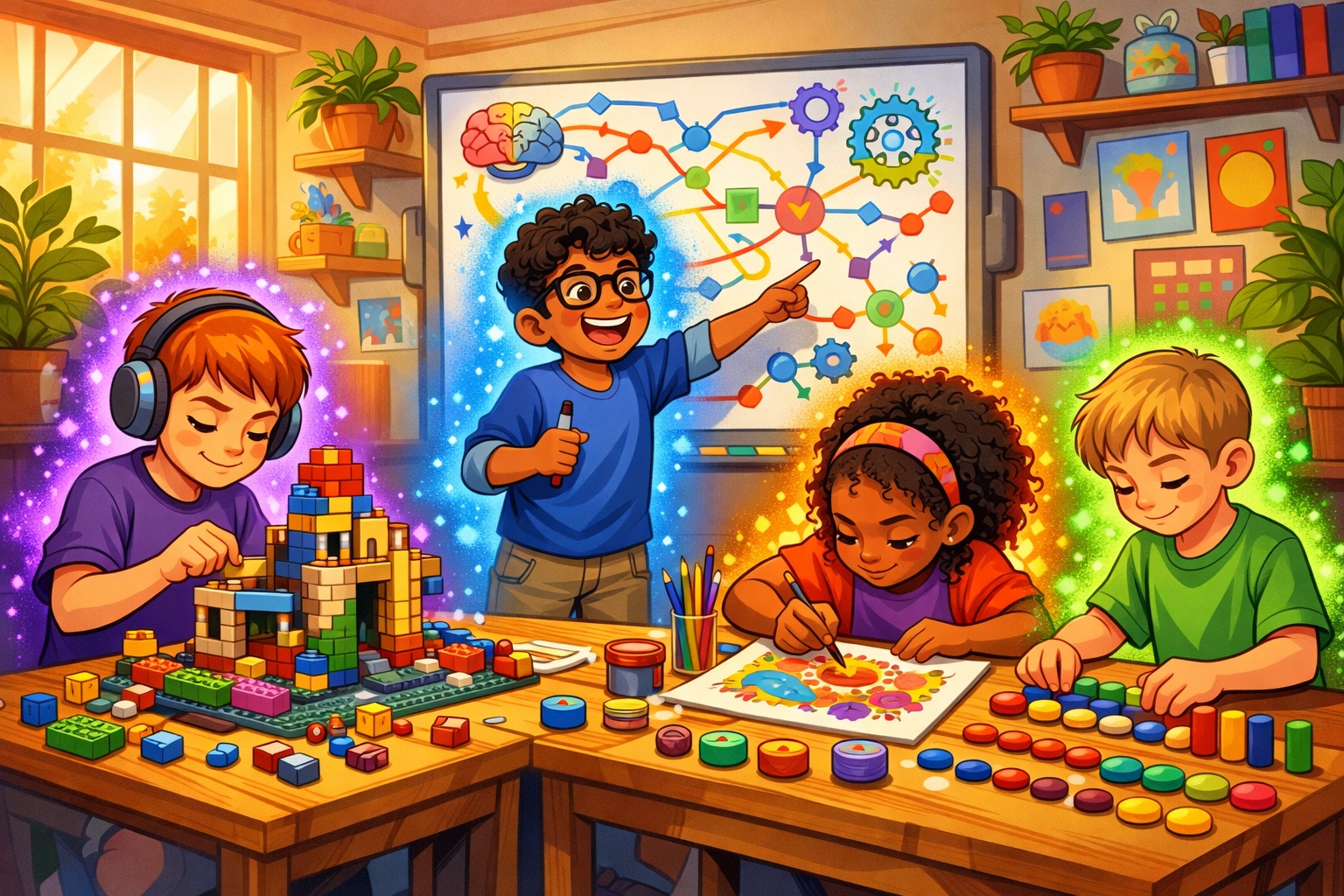
Pattern Recognition and Systems Thinking
Many autistic individuals show enhanced ability to spot patterns, anomalies, and system-level connections that others miss. This isn't about being a "human calculator" (though some are!), it's about seeing how pieces fit together in fields ranging from computer programming to epidemiology to music composition.
In 2026, we're seeing more companies actively recruit autistic workers specifically for roles requiring deep pattern analysis and attention to detail (quality assurance, data analysis, research science). And crucially, these companies are learning to provide accommodations like sensory-friendly workspaces and flexible communication options.
Hyperfocus and Deep Interest Exploration
ADHD brains can struggle with sustained attention on uninteresting tasks, but when interest is high, hyperfocus can lead to extraordinary depth of knowledge and skill development. Kids who spend hours learning every species of frog or memorizing entire movie scripts aren't wasting time; they're developing research skills, building expertise, and experiencing the joy of mastery.
"My son knows more about Renaissance architecture than most college students," says Jennifer Wu, mother of a 12-year-old with ADHD. "Does he struggle to remember his homework assignments? Yes. But his ability to dive deep into topics he cares about has taught him that his brain is capable of incredible things, he just needs the right conditions."
Creative Problem-Solving and Divergent Thinking
Dyslexic thinkers often excel at spatial reasoning, visual thinking, and approaching problems from unexpected angles. This isn't compensation for reading difficulties, it's a genuine cognitive strength. In 2026, we're finally seeing educational assessments that measure these abilities rather than treating them as irrelevant because they don't show up on traditional literacy tests.
Authenticity and Value-Driven Integrity
Many neurodivergent individuals report difficulty with social masking and pretense, which, yes, can create challenges in neurotypical-dominated spaces. But it also means many neurodivergent people bring remarkable authenticity, honesty, and commitment to their values. In a world full of corporate doublespeak and performative allyship, this matters.
How to Talk About Strengths Without the Cringe
So how do we celebrate neurodivergent abilities without falling into toxic positivity or superhero mythology? Here are approaches that actually work:
Be specific. Instead of "your autism is your superpower," try "I notice you're really good at remembering details other people miss" or "your ability to focus on your art for hours is impressive."
Acknowledge both-and. "You have an amazing vocabulary and a real gift for storytelling. I also know that organizing your thoughts in writing is really hard right now, and we're going to keep working on tools that help with that."
Focus on accommodation, not just adaptation. Celebrate your child's strengths while fighting for the accommodations they need. "Yes, you're brilliant at thinking outside the box: and also, your school should be providing you with text-to-speech software."
Let them define it. Ask your neurodivergent kid (or yourself, if you're the neurodivergent adult reading this): "What do you think you're good at? What parts of how your brain works do you actually like?" Their answers might surprise you.
A disability is not an inability: it's a different way of being in the world
Why This Actually Matters in 2026
We're at an interesting cultural moment. On one hand, neurodiversity acceptance has grown significantly: major employers have neurodiversity hiring initiatives, schools are (slowly) implementing more flexible learning approaches, and you can find sensory-friendly spaces in museums and movie theaters.
On the other hand, neurodivergent people still face significant barriers: employment discrimination, educational inequity, and social isolation. The mental health statistics for neurodivergent youth remain concerning.
In this context, strengths-based framing isn't fluffy feel-good nonsense: it's a necessary counterweight to systems that still primarily pathologize difference. When neurodivergent kids grow up knowing their genuine abilities (not inflated myths, but real skills), they're better equipped to self-advocate, pursue careers that fit their strengths, and build lives that work for them rather than constantly trying to fit neurotypical molds.
"I wish someone had told me earlier that my ADHD wasn't just about what I couldn't do," reflects Sarah Mitchell, a 28-year-old graphic designer. "I spent my twenties in jobs that required sustained attention to boring tasks, thinking I just needed to try harder. Once I understood my actual strengths: rapid ideation, creative problem-solving, ability to juggle multiple projects: I restructured my entire career. Now I thrive."
Moving Forward: Strength and Struggle Can Coexist
The truth about neurodivergent strengths in 2026 is this: They're real. They matter. And they don't erase the struggles.
Your child can have an exceptional memory for facts and struggle with emotional regulation. Your student can be brilliantly creative and need extended time on tests. You can be an adult who's found ways to leverage your neurodivergent traits successfully and still have days when executive function feels impossible.
The goal isn't to choose between celebrating strengths or acknowledging challenges: it's to hold space for both. It's to build a world where neurodivergent people can access their genuine abilities while also receiving support for real difficulties.
That's what "disability is your superpower" should mean: not that everything is magically fine, not that you don't need accommodations, not that you have to be exceptional to deserve dignity: but that your brain's differences can include real gifts worth recognizing and cultivating.
And honestly? In 2026, with all the tools, understanding, and community we're building, that's starting to feel less like a motivational slogan and more like a lived reality for more and more neurodivergent kids and adults.
We're not there yet: but we're getting closer. And that matters.
Want to learn more about teaching kids about invisible disabilities and neurodiversity? Check out our resources and join the conversation in our community forums.