
"Freddie, please put your shoes on."
Five minutes pass.
"Freddie, shoes. Now."
Ten minutes pass.
"Freddie! For the tenth time, put on your shoes or we are going to be late!"
If this cycle sounds like a typical Tuesday morning in your house, you aren't alone. For families navigating the beautiful (but often chaotic) world of neurodiversity: including ADHD, autism, and anxiety: verbal instructions can often feel like shouting into a Florida thunderstorm. The information just doesn't land. This happens because many neurodiverse children struggle with executive function (the mental skills we use to manage time, pay attention, and switch focus) and auditory processing.
When your child "ignores" you, they often aren't being defiant; they are likely overwhelmed by the verbal "noise" and are experiencing what experts call time blindness (the inability to sense the passing of time or estimate how long a task will take). To help our kids thrive, we have to move the information from the air (speech) to their eyes (visuals).
But which tool should you choose? Should you stick with a traditional physical visual timer, or is it time to upgrade to a comprehensive system like the Cozyla Digital Calendar? Let’s dive into the swamp and find out.
The "Sprint" Tool: Why Traditional Visual Timers Still Have a Place
Pictured below: Shelly the Turtle using a physical timer to keep her morning pace steady without feeling rushed.

A traditional visual timer: like the classic ADHD Focus Tracker Chart or a physical Time Timer: is what we call a "sprint" tool. Its primary job is to answer one specific question: "How much time do I have left right now?"
These tools usually feature a bright red disc that disappears as time passes. As one parent, Sarah M., shared with us: "The visual timer was a game-changer for transitions. Before, turning off the iPad was a battle. Now, my son watches the red sliver get smaller and smaller. By the time it’s gone, his brain has already processed that the activity is over. No more meltdowns."
The Benefits of Visual Timers:
- Zero Distraction: There are no apps, notifications, or bright lights to pull a child away from the task.
- Portability: You can move a physical timer from the kitchen table to the bathroom during tooth-brushing.
- Instant Understanding: Even very young children who can't tell time yet can understand that "when the red is gone, we go."
However, timers have a major limitation: they don't tell you what is coming next. They manage the "now," but they don't manage the "day." This is where things can get tricky for kids like Freddie the Zoomy Frog, who need to see the "Big Picture" to feel safe and regulated.
The "Marathon" Tool: The Power of a Digital Command Center
If a visual timer is for the sprint, a digital calendar like the Cozyla Digital Calendar is for the marathon. It doesn't just manage one task; it manages the entire family ecosystem.
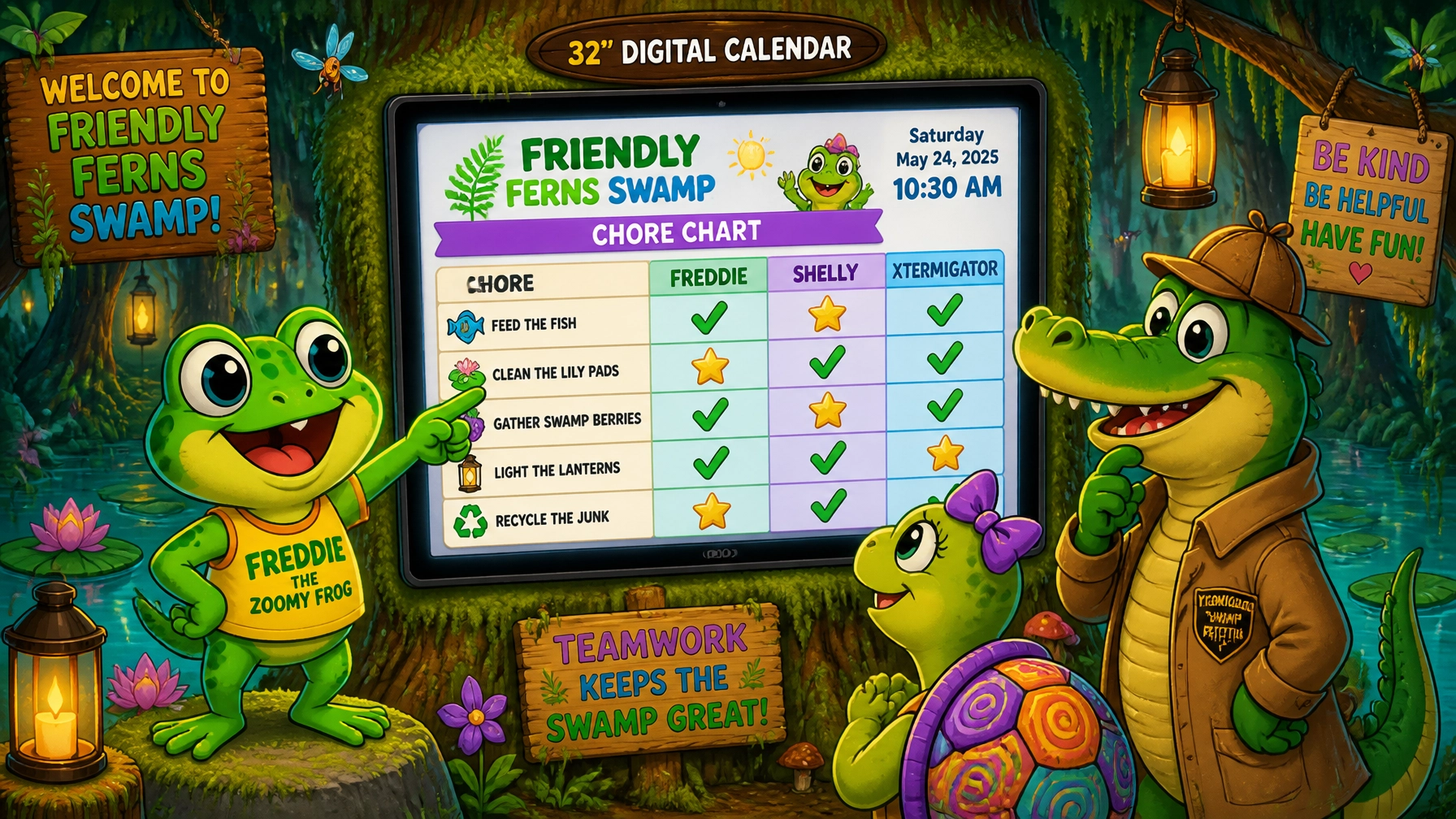
Below: A look at how the Cozyla screen organizes the swamp with color-coded schedules and icons.

The Cozyla Digital Calendar (a large, wall-mounted touchscreen that syncs with Google, iCloud, and Outlook) acts as a "Single Source of Truth" for the household. When a child asks, "When is soccer?" or "What’s for dinner?", you don't have to answer. You just point to the board.
"Having the Cozyla in our kitchen changed the tone of our entire house," says Mark, a father of two neurodiverse girls. "It stopped the 'nagging cycle.' The kids check their own chore charts, see their points, and know exactly what the sequence of the evening looks like. It’s the house rules, not Dad’s rules."
Technical Features that Support Neurodiversity:
- Always-On Visibility: Unlike a phone app that stays hidden in a pocket, the Cozyla stays visible on the wall, providing constant visual scaffolding (the supportive structures that help a child reach a goal they couldn't achieve alone).
- Gamified Chore Tracking: You can assign chores (like 'Feed the Gator') and assign points. Kids love checking the box themselves to see their "streak" grow.
- Customizable Dashboards: You can add widgets for the weather, meal plans, and even YouTube videos for "How-To" tasks.
- Color-Coding: Each family member gets a color. For an autistic child who thrives on pattern recognition, seeing "Green is for Freddie" makes the schedule instantly readable without needing to process complex text.
Side-by-Side: Which Tool Wins?
To decide which is right for your family, consider the primary challenge you are trying to solve.
| Feature | Traditional Visual Timer | Cozyla Digital Calendar |
|---|---|---|
| Primary Goal | Task duration (The "Now") | Daily sequence (The "Next") |
| Independence | Helps stay on task | Helps manage the whole day |
| Setup | Seconds | Initial setup required (Syncing) |
| Cost | Budget-friendly | Investment ($$) |
| Best For | Focus and transitions | Routine and family coordination |
The "Secret Sauce": Using Both for Maximum Success
In the Friendly Ferns Swamp, we’ve found that the most successful families don’t actually choose between the two: they use them together.
Imagine this: The Cozyla Digital Calendar tells Freddie that at 4:00 PM, it is "Homework Time." Freddie sees his name in green and knows exactly what he needs to do. Once he sits down at the table, he sets his visual timer for 20 minutes. He uses the digital calendar to find his place in the day and the visual timer to find his focus in the moment.
This combination creates a powerful emotional transformation. When a child knows what to expect, their anxiety levels drop. When they have the tools to manage themselves, their confidence soars. They stop being "the kid who can't listen" and start being the kid who is in charge of their own "superpowers."
Pictured: The peace that comes when the whole family is on the same page.

Looking Toward a Calmer Future
At XTERMIGATOR KIDS, we believe that a disability is not an inability: it’s just a different way of processing the world. Whether you start with a simple printable scavenger hunt to build engagement or invest in a full Cozyla Digital Calendar system, you are taking a step toward a more inclusive and peaceful home.
The future of family organization isn't about "fixing" our neurodiverse kids; it’s about fixing the environment so they can shine. Imagine a morning where you don't have to raise your voice once. Imagine a dinner where everyone knows what’s happening tomorrow. That’s the "Swamp Life" we want for every family.
Ready to start your journey? Check out our Resource Hub for more tips on navigating unseen disabilities with courage and kindness.
Note: For families just starting out, we recommend downloading our free Shelly the Turtle Worksheets to help introduce the concept of patience and visual schedules to your little ones.