
It’s that sinking feeling in your stomach: the one every parent of a neurodiverse child knows all too well. Maybe it’s the first day of school, a new substitute teacher, or even a weekend visit to a relative's house. You’re standing there, trying to sum up years of complex sensory needs, communication styles, and behavioral nuances in a thirty-second "handover" while your child is already starting to feel the buzz of a new environment.
You want to say, "He’s brilliant at math but can't stand the sound of the pencil sharpener," or "She’s non-verbal but understands everything you say," but the words get tangled. You leave feeling anxious, and your child is left with someone who doesn’t yet have the "user manual" for their beautiful, unique brain.
As Dr. Eric Fishon, founder of Xtermigator Kids, often says: "A disability is not an inability: it’s your greatest superpower. But even superheroes need a way to tell their story to the world."
What if you could hand over a "Superpower Passport" that did the talking for you? A simple, one-page document that transforms your child from a "collection of symptoms" into a vibrant hero with specific needs and incredible strengths.
In this guide, we’re going to show you how to build one in just five minutes, with a little help from our friends at Friendly Ferns Swamp.
Why Your Child Needs a "Superpower Passport" (And Not Just an IEP)
While Individualized Education Programs (IEPs) are essential legal documents, they are often long, clinical, and: let’s be honest: a bit dry. They focus heavily on deficits. A Superpower Passport is different. It’s a strengths-based (focusing on what a person is good at rather than just their challenges) communication tool.
"When we first brought Romeo's passport to his track coach, the change was instant," shared Sarah, a mom in our community. "Instead of seeing an 'energetic kid who doesn't listen,' the coach saw a 'Hyper-focus Hero' who needed visual cues to transition. It changed the entire season for him."
By creating this passport, you are practicing self-advocacy (the ability to represent one's own needs and interests). You’re teaching your child that their brain isn't "broken": it’s just wired for a different kind of adventure.
Meet the "Superpower" Consultants of Friendly Ferns Swamp
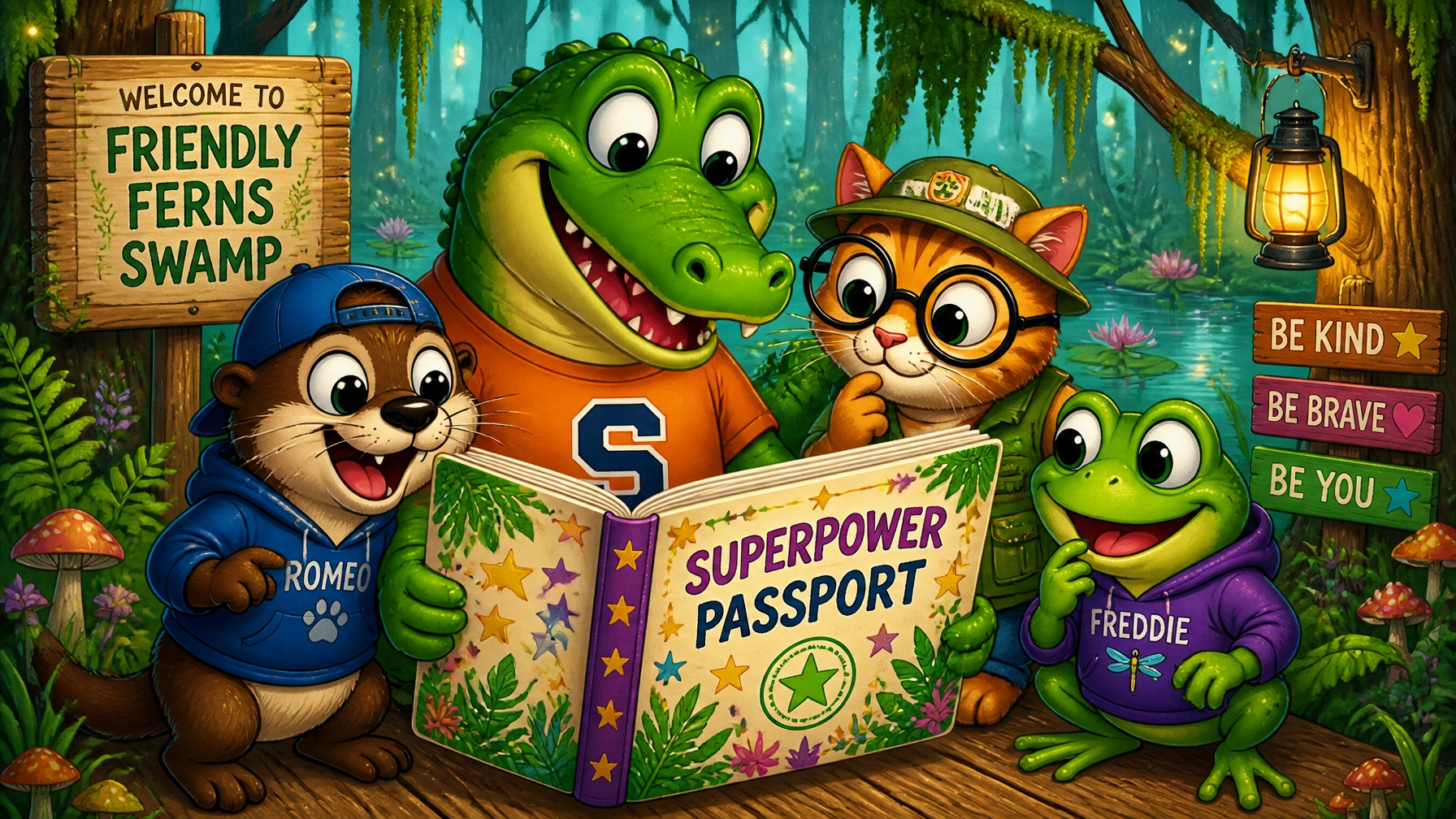
Before we dive into the steps, let’s see how the crew at the swamp handles their own passports. Every character you meet at Xtermigator Kids uses their differences to help the team.
- Romeo is our resident otter with ADHD. His superpower? Hyper-focus. When he's on a mission, nothing can stop him! His passport tells people that he needs "Movement Breaks" (short bursts of physical activity to help reset the brain) to keep his engine running smooth.
- Tebow is a cat who is non-verbal. His superpower? Observation. He sees details others miss. His passport explains how he uses his AAC device (Augmentative and Alternative Communication tools like tablets or picture boards) to share his brilliant ideas.
- Freddie the Frog often deals with big worries. His superpower? Empathy. He can feel what others are feeling. His passport lets teachers know that "Sensory Overload" (when the environment provides more input than the brain can process) makes him need his "Calm Corner."

Romeo knows that knowing your strengths is the first step to being unstoppable.
The 5-Minute Blueprint: Building Your Passport
You don't need a degree in special education to do this. You just need five minutes and a heart full of love for your kiddo. Grab a piece of paper (or use our digital template) and follow these four simple steps.
Step 1: Identify the "Superpowers" (2 Minutes)
Start with the good stuff. What makes your child’s eyes light up? What can they do better than anyone else?
- Is it their memory? (The "Data Guardian")
- Is it their creativity? (The "Imagineer")
- Is it their honesty? (The "Truth Teller")
Italicized Context: Always involve your child in this step if possible. Even if they are non-verbal like Tebow, you can watch what they gravitate toward and include those as their 'Heroic Interests.'
Step 2: Define "How My Brain Works" (1 Minute)
Use this section to explain executive functioning (the mental skills that help us plan, focus, and multi-task). This is where you translate "behaviors" into "needs."
Instead of saying "He gets distracted," try: "My brain is a high-speed processor that notices everything! I work best with short, 1-step instructions."
Instead of saying "She's sensitive," try: "I have 'Super-Senses.' Sometimes the world is too loud, and I need my noise-canceling headphones to keep my focus."
Step 3: The "Rescue Kit" (1 Minute)
What are the three things that help your child when they are feeling dysregulated (unable to manage emotional responses)?
- Example 1: A 5-minute timer (like the one on the Cozyla Digital Calendar) to help with transitions.
- Example 2: Heavy work (activities like pushing or pulling that provide calming sensory input).
- Example 3: A "Quiet Code" (a secret hand signal to let an adult know they need a break).

Tebow uses his 'Rescue Kit' icons to show he needs a quiet space when the swamp gets too noisy.
Step 4: Add a Heroic Photo (1 Minute)
Include a photo of your child doing something they love. It reminds the reader that they are looking at a real, multi-dimensional person, not just a list of accommodations.
From Meltdown to Mastery: The Emotional Transformation
The real magic of the Superpower Passport isn't just the information: it’s the shift in perspective. When a teacher sees a "Superpower Passport," they stop looking for what's "wrong" and start looking for how to help that child's light shine.
"I used to feel like I was a problem to be solved," says 10-year-old Leo, who helped design his own passport. "But now my teacher knows I'm a 'Pattern Seeker.' She asks me to help organize the classroom library because she knows my brain loves patterns. I feel like a leader now."
This is the goal of everything we do at the Friendly Ferns Swamp. We want every child to feel like Xtermigator: strong, capable, and ready to take on the world, one lily pad at a time.
Putting Your Passport to Work
Once you've created your passport, what do you do with it?
- Print several copies. Put one in the backpack, one in the glove box, and one on the fridge.
- Laminate it. (Or just put it in a clear plastic sleeve). Swamps can get messy!
- Share it digitally. Send a PDF to teachers, therapists, and even the "cool aunt" who babysits on Fridays.
- Integrate it with your schedule. If your passport says your child needs a visual routine, make sure those routines are reflected on your family organization tools.

A completed passport is a bridge between a child's world and the people who care for them.
Looking Toward a Neuro-Inclusive Future
Our hope is that one day, every child: neurodiverse or neurotypical: will have a "Superpower Passport." Imagine a world where we lead with our strengths instead of our labels.
As we continue to grow the Xtermigator Kids community, we are constantly looking for ways to make these tools more accessible. Whether it's through our personalized tutoring or our "Xtermigator's Big Heart" book series, our mission remains the same: to prove that "Different is Beautiful."
So, take five minutes today. Sit down with your little hero. Ask them what their superpowers are. You might be surprised at what they tell you: and you’ll definitely be glad you have the passport to share it with the world.
Want to dive deeper into the world of Friendly Ferns Swamp? Check out our latest stories and resources on YouTube or join the conversation in our Community Forum.