
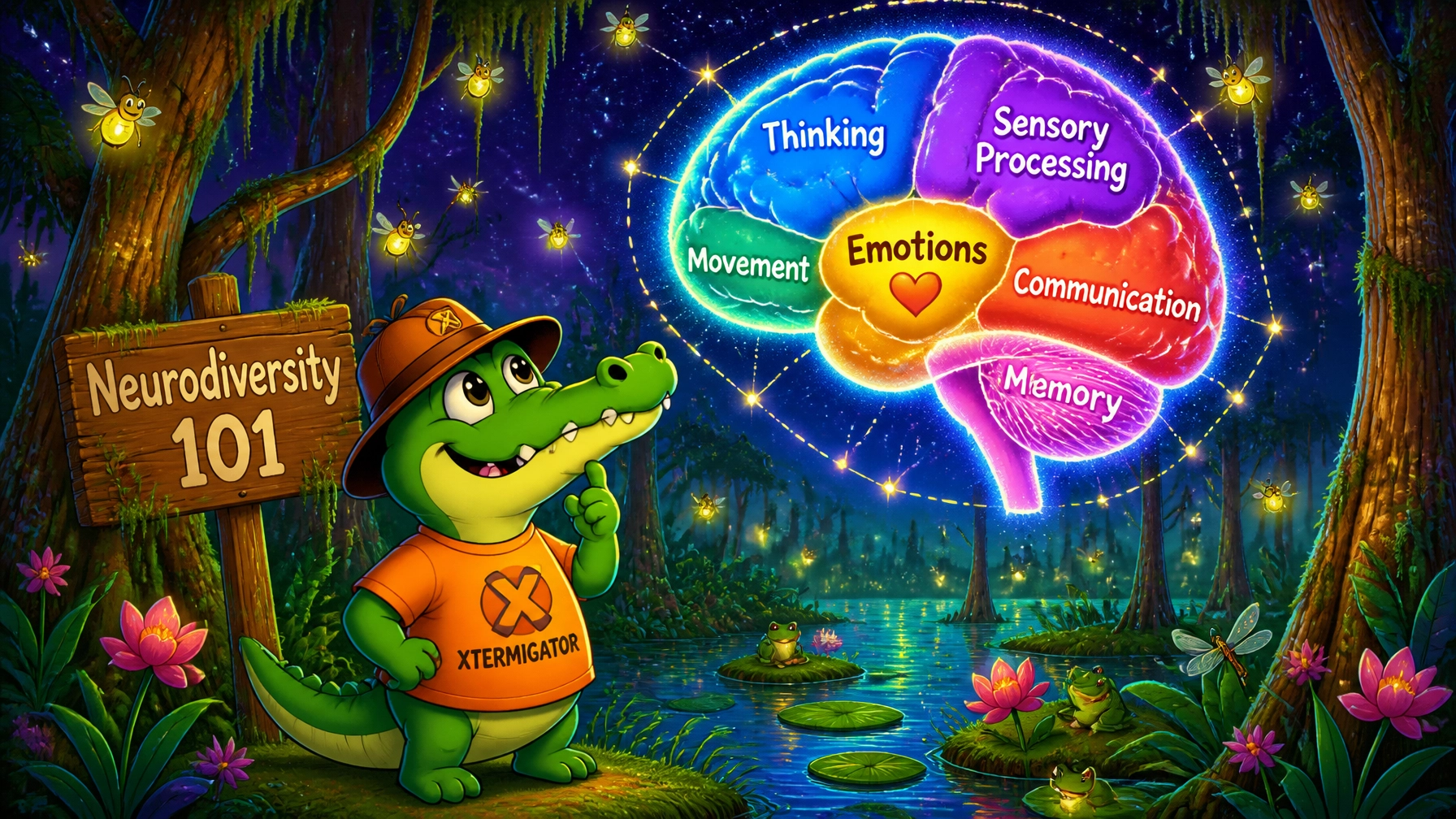
It usually starts with a feeling of being completely lost in a thick, morning fog, much like the mist that settles over the Friendly Ferns Swamp before the sun peeks through. You’re watching your child struggle with a task that seems "simple" for others, or perhaps you’ve just walked out of a meeting with a specialist holding a folder full of terms like ADHD, ASD, or Generalized Anxiety. Your heart is heavy, your mind is racing, and you’re wondering if you have the map to navigate this new territory.
"When we first realized our son’s brain worked differently, it felt like we were speaking a different language than the rest of the world," says Maria, a mother of a 7-year-old with ADHD. "We saw his brilliance, but the world only saw his 'behaviors.' We didn't need a cure; we needed a translation guide."
At XTERMIGATOR KIDS, we believe that the fog doesn't have to be scary. In fact, some of the most beautiful parts of the swamp are only visible when you learn how to look at them differently. This guide is your first step in understanding that neurodiversity isn't a problem to be solved, it’s a landscape to be explored.
The Brain’s Unique Map: Why Different is Your Greatest Superpower
Neurodiversity is the idea that neurological differences (the ways our brains are wired) are a natural and valuable part of human diversity. Just as the Friendly Ferns Swamp needs the slow-and-steady Shelly the Turtle and the high-energy Zoomy Frog to thrive, our world needs different types of thinkers.
"The old way of thinking was focused on 'fixing' the child to fit the classroom," explains Dr. Aris Marsh, an educational consultant (an expert who helps schools create inclusive environments). "The neurodiversity paradigm shifts that focus. We ask: How can we change the environment so this unique brain can shine? When we stop trying to 'fix' neuroplasticity (the brain's ability to change and adapt throughout life), we start witnessing true genius."
Shelly the Turtle reminds us that being observant and patient is a quiet kind of strength.
When we talk about neurodiversity, we are often talking about neurodivergent individuals, those whose brains function, learn, and process information differently than what is considered "typical." This includes:
- ADHD (Attention-Deficit/Hyperactivity Disorder): Often characterized by high energy, spontaneity, and out-of-the-box thinking.
- Autism: Which can involve unique ways of communicating, deep interests, and a high attention to detail.
- Anxiety: A heightened state of alertness that, while challenging, often comes with deep empathy and careful planning.
The core message at the heart of everything we do is simple: A disability is not an inability, it’s your greatest superpower.
Decoding the Swamp Creatures: Understanding ADHD, Autism, and Anxiety
To support the kids in our lives, we have to understand the specific "terrains" they are navigating. Let's look at how these differences manifest and the "superpowers" they often hide.
ADHD: The "Zoomy Frog" Energy
Kids with ADHD often struggle with executive function (the mental skills that help us plan, focus, and multi-task). They might lose their shoes for the fifth time today, but they are also the ones who will find a creative solution to a problem that stumped everyone else.
"My daughter doesn't just have energy; she has 'spark,'" says Kevin, a father of a 10-year-old. "Once we stopped fighting her need to move and started giving her 'movement snacks' (short breaks to jump or run during homework), her confidence soared. She’s not distracted; she’s just noticing everything at once!"
Autism: The Observant Detective
Autistic children may process sensory input (information received through the senses like sound, light, and touch) more intensely. While a crowded room might feel like a thunderstorm to them, their ability to notice patterns and details is unmatched.
A group of diverse swamp characters celebrating their unique strengths together.
"In the 'Xtermigator & The Zoomy Frog' book, we see characters learning to navigate these feelings with kindness," says Eric Fishon, owner of XTERMIGATOR KIDS. "We want kids to see themselves in Xtermigator or Tebow the Cat. We want them to say, 'Hey, I’m observant and loyal just like Tebow!'"
Anxiety: The Empathetic Guardian
Anxiety is often the "unseen passenger" for many neurodivergent kids. It’s a feeling of worry that can make the swamp feel dangerous. However, anxious children are often the most empathetic members of a group. They are sensitive to the feelings of others and are incredibly thoughtful in their actions.
Tools for the Journey: From Visual Calendars to Sensory Shelters
Understanding the brain is the first step, but what does support look like on a Tuesday afternoon when the homework is piling up? It looks like practical tools that respect the child's neurotype.
One of our favorite digital tools for families is the Cozyla Digital Calendar. For a child who struggles with time awareness or transitions, a visual schedule isn't just a "nice to have": it’s an anchor.
"Using a visual schedule changed our mornings from a battlefield to a team effort," shares Sarah, a teacher and mom. "When my son can see the Xtermigator icon for 'Brush Teeth,' he feels in control. It supports his autonomy (his ability to make his own choices and manage himself) without me having to nag."
A family using the Cozyla Digital Calendar to organize their day with Friendly Ferns characters.
In the classroom, support might look like:
- Sensory Breaks: Allowing a student to wear noise-canceling headphones or spend five minutes in a "quiet lily pad" corner.
- Differentiated Instruction: Teaching a lesson through storytelling (like our book series!) rather than just a lecture.
- Positive Reinforcement: Focusing on the effort and the "superpower" rather than just the grade.
Real Stories from the Friendly Ferns: Emotional Transformation Moments
We often hear from parents who say their child's "breakthrough" didn't happen in a doctor's office, but while reading a story.
"We were reading 'Xtermigator’s Big Heart' series, and my son stopped and pointed at the page," says Linda, a grandmother. "He said, 'Gigi, the alligator feels like his heart is too big for his shirt, just like me!' For the first time, he didn't feel weird. He felt represented. That was the moment his anxiety started to lift and his self-acceptance began."
These moments of transformation happen when we bridge the gap between "education" and "entertainment." By using whimsical swamp characters, we take the "scary" out of disability and replace it with "superpower."
The characters of Friendly Ferns Swamp show us that we are unstoppable when we work together.
Looking Toward a Brighter, More Inclusive Swamp
As we look to the future, our hope is that "Neurodiversity 101" becomes common knowledge in every home and classroom. We envision a world where a diagnosis isn't a weight, but a key: a key that unlocks the specific tools and supports a child needs to fly (or hop, or crawl, or swim!).
We are constantly expanding our resource hub with free educational materials, personalized tutoring, and new stories in the "Xtermigator's Big Heart" series. Our mission is to keep building a community where every child knows they belong.
Remember, the swamp is a big, beautiful place, and there is a lily pad for everyone. If you’re feeling lost, just look for the Xtermigator: he’s got his magnifying glass ready, and he’s more than happy to help you find your way.
Ready to dive deeper? Check out our latest YouTube stories or grab a copy of "Xtermigator & The Zoomy Frog" to start the conversation with your little explorer today!