
It usually starts with a phone call from the teacher or a frustrated sigh over a math worksheet. Maybe your child can’t sit still for ten minutes, or perhaps they get so lost in a drawing that the rest of the world disappears. You see their brilliance: the way they remember every detail about space or how they can spot a tiny beetle in the grass from twenty feet away: but the "system" sees a problem. You’re told they are "falling behind" or "struggling to focus," and suddenly, your child’s unique spark feels like a heavy weight they have to carry.
That sinking feeling in your chest? We’ve been there. At XTERMIGATOR KIDS, we believe that the world’s biggest mistake is trying to fit a magical, "zoomy" frog into a box designed for a slow-moving snail. When we look at neurodiversity (the concept that brain differences like ADHD and Autism are natural human variations rather than defects), we don't see a "disorder." We see a superpower waiting to be unlocked.
Redefining the Brain: Moving from "Disability" to "Different Ability"
For a long time, the world of education followed a "medical model" (an approach that focuses on fixing what is perceived as "wrong" with a person). If a child’s brain didn't process information like everyone else's, the goal was to make them blend in. But neurodiversity flips that script. It suggests that ADHD, autism, dyslexia, and anxiety are simply different "operating systems" for the human brain.
As one parent from our Friendly Ferns community recently shared, "I spent years trying to make my son 'normal.' It wasn't until I stopped trying to fix him and started trying to understand him that I realized his ADHD wasn't his weakness: it was his engine. He doesn't just think outside the box; he doesn't even see the box."
When we talk about neurodiversity, we’re talking about specific technical strengths that often come bundled with these invisible disabilities:
- Hyperfocus (a state of intense concentration on a subject of interest): Many autistic children can develop deep expertise that rivals professionals.
- Divergent Thinking (the ability to generate many unique solutions to a problem): Those with ADHD are often natural innovators and creative powerhouses.
- Spatial Reasoning (the capacity to think about objects in three dimensions): This is a hallmark of the dyslexic brain, making them incredible engineers and artists.
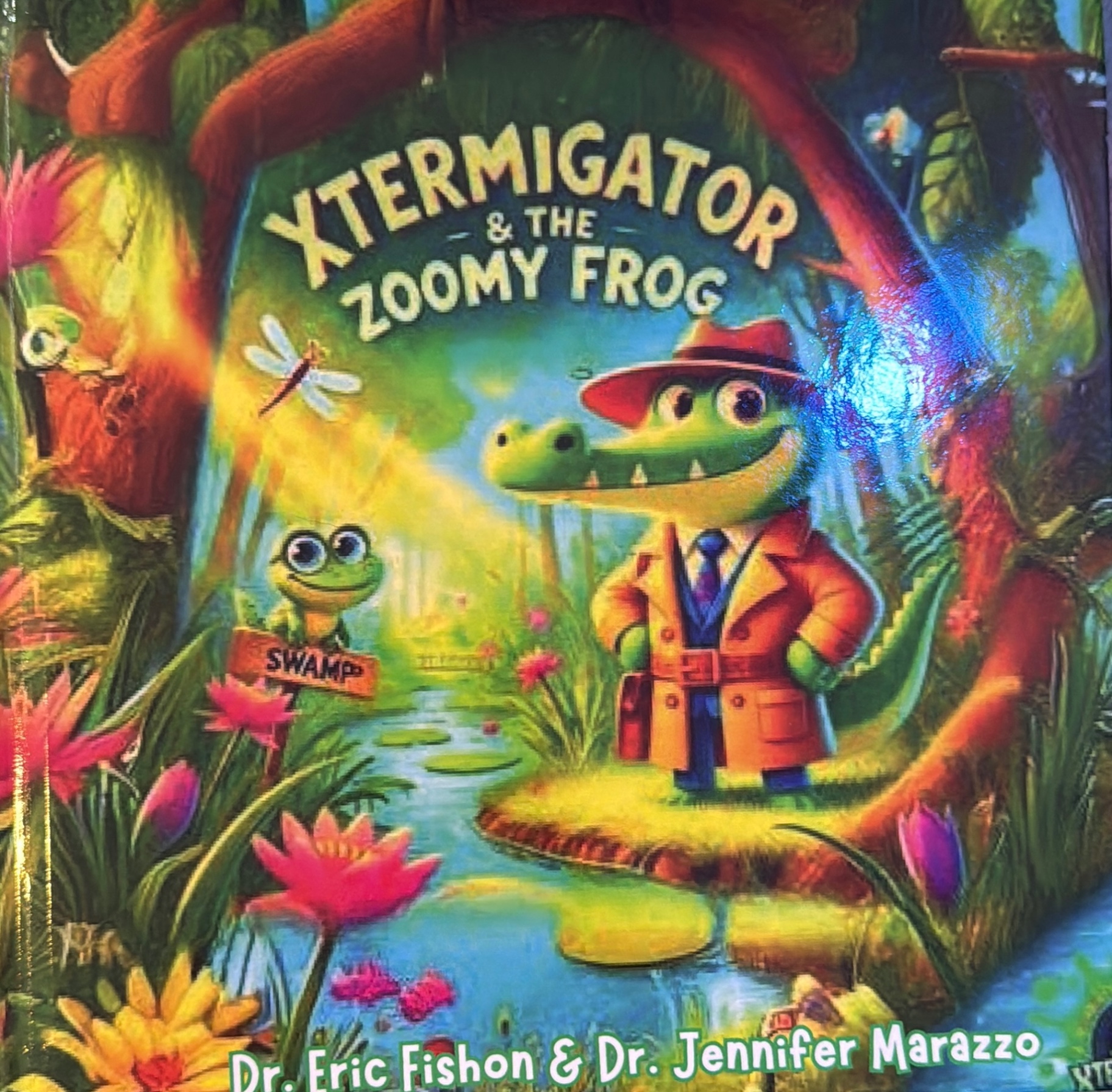
Our friend Xtermigator knows that every case in the swamp requires a different kind of brain to solve!
The Swamp Perspective: Learning with the Friendly Ferns Crew
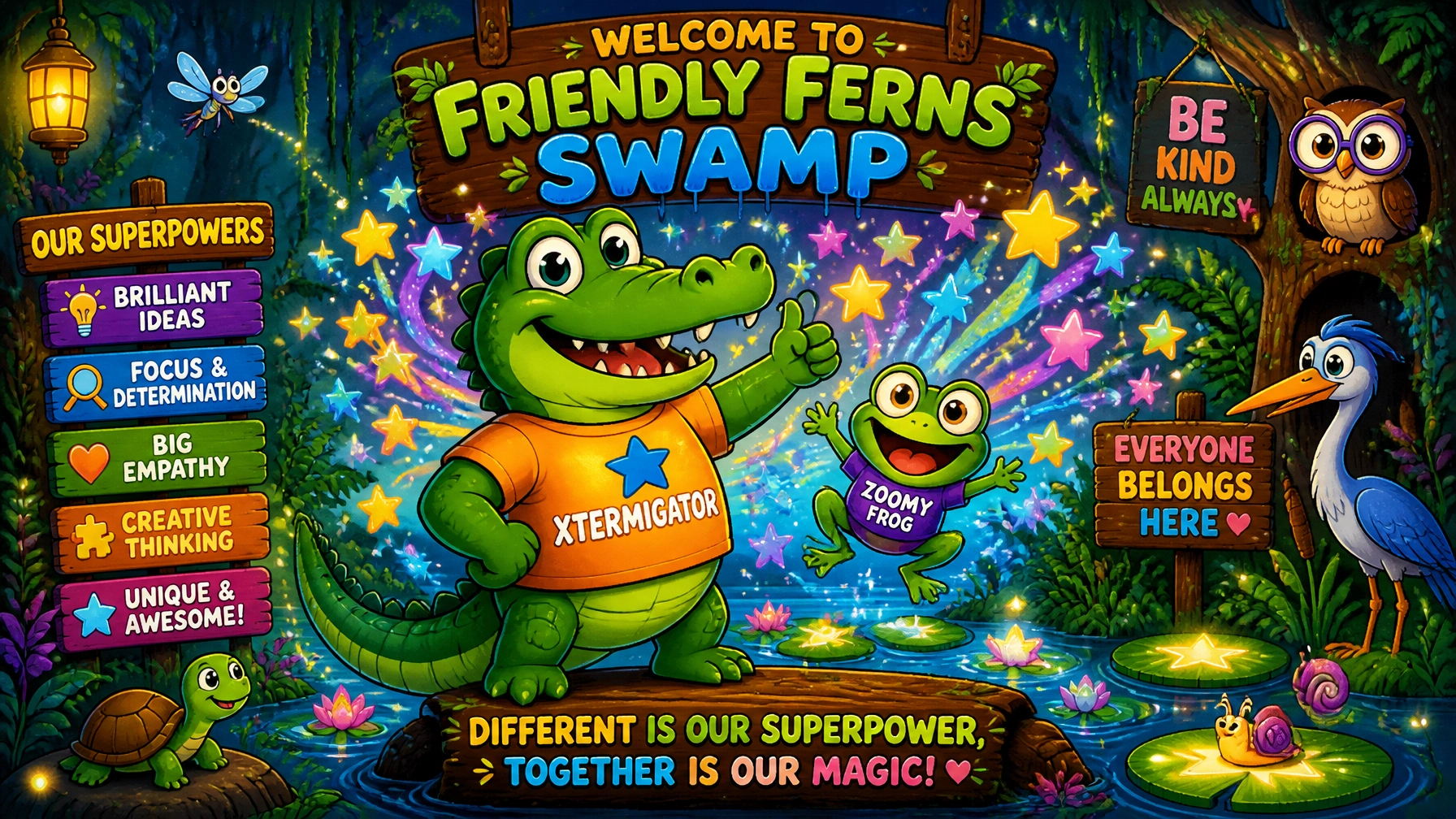
In our Friendly Ferns Swamp, we don't just teach kids about their brains; we show them characters who live it every day. Take the Zoomy Frog, for instance. He’s got more energy than a lightning bolt! In a traditional classroom, he might be told to "sit still," but in the swamp, his speed is what makes him a hero.
Then there’s Shelly the Turtle. Shelly might take a little longer to process things, and she needs a calm environment to feel safe. We use Shelly to teach children about Executive Function (the mental skills that help us plan and stay organized). Shelly doesn't need to be "faster": she just needs the right tools to navigate at her own pace.
"The characters make it real for my students," says Sarah, a 2nd-grade inclusion teacher. "Instead of saying 'You have autism,' I can say 'You have a brain like Shelly: you notice the tiny details others miss.' It changes their entire self-image from 'broken' to 'specially equipped.'"
Emotional Transformation: The Moment the Lightbulb Flickers On
The most beautiful thing we see at XTERMIGATOR KIDS is the "Aha!" moment. It’s that second when a child realizes that their brain isn't a mistake. One mother told us about her daughter, who struggles with severe anxiety and sensory processing issues. For years, her daughter felt like a "problem child."
"We started reading the Xtermigator’s Big Heart series," she recalled. "She saw Tebow the Cat: who is observant and sensitive: and she just stopped and said, 'Mom, I’m not weird. I’m just observant like Tebow.' She started standing taller that day. She went from hiding in the back of the room to volunteering to lead the class nature walk."
This is the power of a strengths-based approach (a way of supporting children that focuses on what they CAN do rather than what they CAN’T). When we validate a child's experience, we reduce "masking" (the exhausting act of hiding neurodivergent traits to fit in), which is the number one cause of burnout and depression in neurodiverse kids.

Finding your path in the swamp is easier when you have a loyal friend and a brain that sees the way.
Practical Tools for Supporting Your Little Superheroes
Understanding is the foundation, but structure is the scaffolding that lets these superpowers shine. Because neurodivergent brains often struggle with time blindness (the inability to sense the passing of time), we recommend tools that provide visual clarity.
One of our favorite resources is the Cozyla Digital Calendar. It’s not just a tool for parents; it’s a way to give a child autonomy. By seeing their day laid out with visual cues, they don't have to constantly ask "what's next?" which lowers anxiety and boosts confidence.
Pro-tip for the Swamp: Pair digital tools with our Shelly the Turtle worksheets to help your child identify their own "Swamp Strengths."

Using worksheets like this helps children reflect on their own superpowers in a fun, pressure-free way.
A Future Where "Different" is the Standard
We aren't just trying to help kids survive school; we’re trying to build a world that celebrates their existence. Imagine a boardroom ten years from now where a dyslexic creative director, an autistic data analyst, and an ADHD project manager are working together. That team would be unstoppable because they all see the world through a different lens.
Our goal at XTERMIGATOR KIDS is to ensure that every child: whether they are a zoomy frog, a patient turtle, or a loyal cat: knows that they belong. We hope to see more schools adopting inclusion programs that don't just "tolerate" neurodiversity but actively seek it out.
As we always say at the Fern Fort: A disability is not an inability: it’s your greatest superpower.
Ready to start your swamp adventure? Check out our Community Forum to connect with other parents and educators who are championing neurodiversity every single day.