From the Swamps of Friendly Ferns
When Stories Come Alive, More People Get a Chance to Be Understood
XTERMIGATOR Kids is excited to collaborate with AIWriteBook and explore how accessible storytelling technology can help children, families, educators, and people living with invisible disabilities turn lived experiences into stories that others can see, hear, and understand.
A message from our friends in the swamp
Down in the Swamps of Friendly Ferns, the cattails are rustling, the lily pads are buzzing, and the storybook has opened to a brand-new chapter.
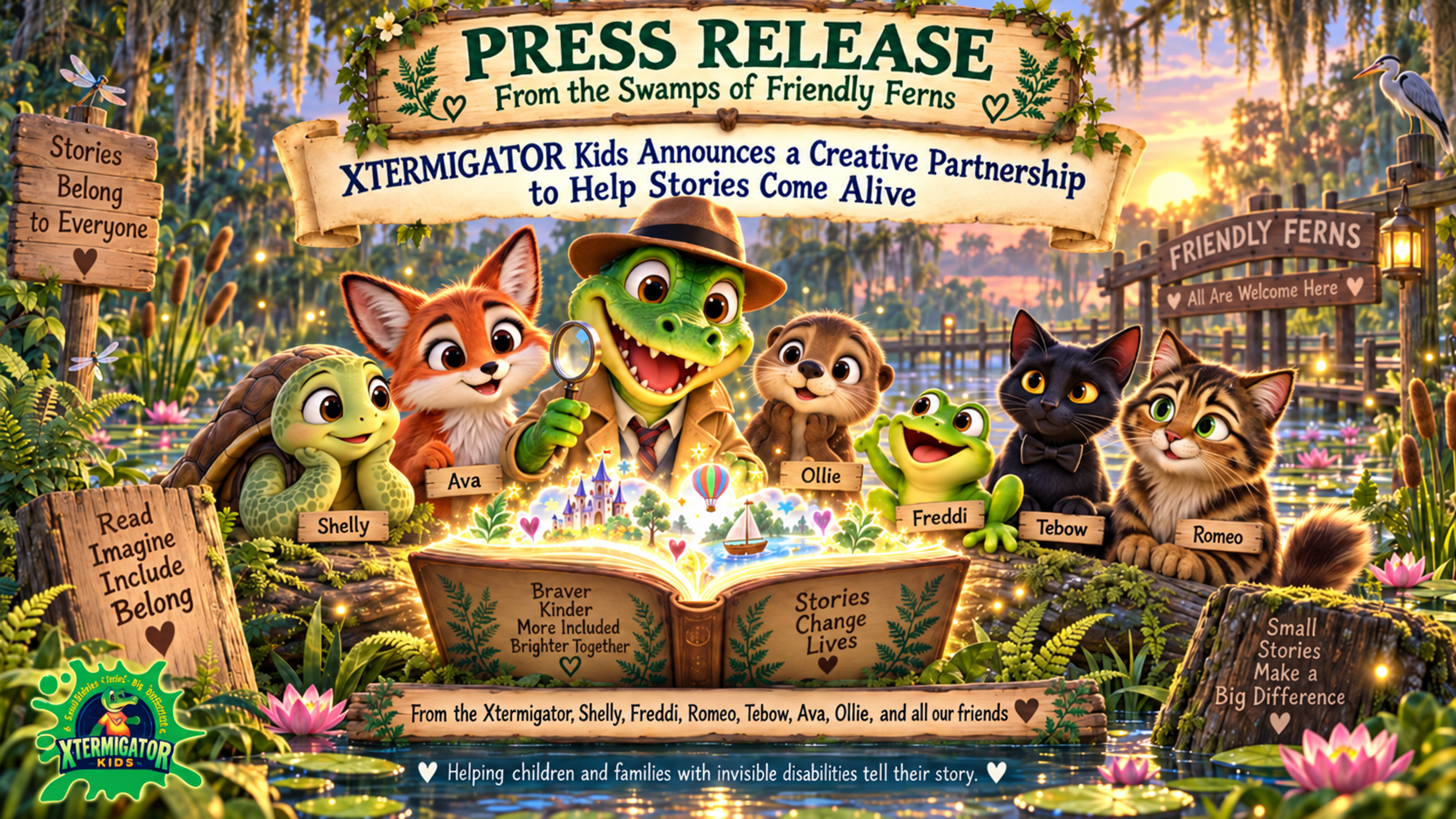
From the Xtermigator, Shelly, Freddi, Romeo, Tebow, Ava, Ollie, and all our friends, we are thrilled to share a creative collaboration with AIWriteBook. Thanks to the support of its founder, we have an opportunity to explore how its book-building and illustration tools can help the stories at the heart of XTERMIGATOR Kids become more vivid, more accessible, and easier to share.
“Technology should not replace someone’s voice. It should help more people find, organize, express, and amplify their own voice.”
Why this matters for invisible disabilities
Invisible disabilities can create a second challenge beyond the disability itself: having to explain an experience that other people cannot immediately see. Storytelling can make that experience tangible without turning a person into a diagnosis.
Turn experience into story
A child or adult may find it easier to explain sensory overload, fatigue, attention differences, anxiety, or accommodation needs through a character and a narrative.
Reduce the blank-page barrier
Structured prompts, outlines, visual storytelling, and editing support can help people who know what they want to say but struggle to organize it into a finished book.
Build empathy and belonging
A story lets readers experience a perspective rather than simply read a definition. That can help families, classmates, educators, and communities better understand one another.
Every person has a story worth telling.
For people living with invisible disabilities, telling that story is not always easy. A student may struggle to explain why a noisy classroom feels overwhelming. A parent may spend years trying to translate a child’s needs for teachers, doctors, family members, and friends. An adult may know exactly what they experience but find the mechanics of writing, organizing, illustrating, or publishing too difficult to navigate alone.
That is where storytelling technology becomes interesting to us. Not because a computer should author a person’s life, but because the right tools can remove barriers between “I wish people understood this” and “Here is a story that helps you understand.”
Imagine a child building a character who feels overwhelmed by the cafeteria, needs extra time to process directions, or becomes exhausted in ways friends cannot see. That experience can become a character. The character can become a story. And the story can become a bridge.
For XTERMIGATOR Kids, that bridge can extend even further: from storybook to activity guide, classroom lesson, family conversation, disability-awareness resource, and accessible digital experience.
AIWriteBook
An AI-powered writing studio designed to help creators move from an idea or existing draft through writing, illustration, formatting, and publishing.
Explore AIWriteBookWhy AIWriteBook caught our attention
AIWriteBook describes a workflow that brings planning, writing, visual storytelling, cover creation, and publishing tools into one place. For children’s book creators, it specifically highlights consistent character illustrations, picture-book and early-reader formats, and a workflow where writing and visuals can be developed together.
Start from an idea or draft
Creators can begin with notes, partial manuscripts, or an existing draft instead of starting over.
Character consistency
The children’s-book workflow is designed to keep recurring characters and visual style consistent across illustrated pages.
Story and visuals together
Writing, illustrations, storyboarding, and visual-book development can live in one workflow.
Finished-book options
The platform supports cover creation and exports including PDF, EPUB, and DOCX for broader publishing workflows.
AIWriteBook feature descriptions are summarized from its public website, accessed September 2026. Product capabilities may change; visit AIWriteBook for current details.
Storytelling as advocacy—without losing the storyteller
Our goal is not to hand a person’s story over to artificial intelligence. It is to investigate how technology can support authorship: helping someone capture ideas, organize a narrative, create visual supports, revise language, and move toward a finished resource while keeping the lived experience at the center.
That distinction is especially important in disability storytelling. The person is not a prompt. Their experience is not raw material for a machine. The individual remains the author of what the story means.
When technology is used well, it can act as a scaffold. It can help reduce friction for people who experience executive-function challenges, communication barriers, fatigue, difficulties with written expression, or simply the overwhelming number of steps between having an idea and holding a finished book.