
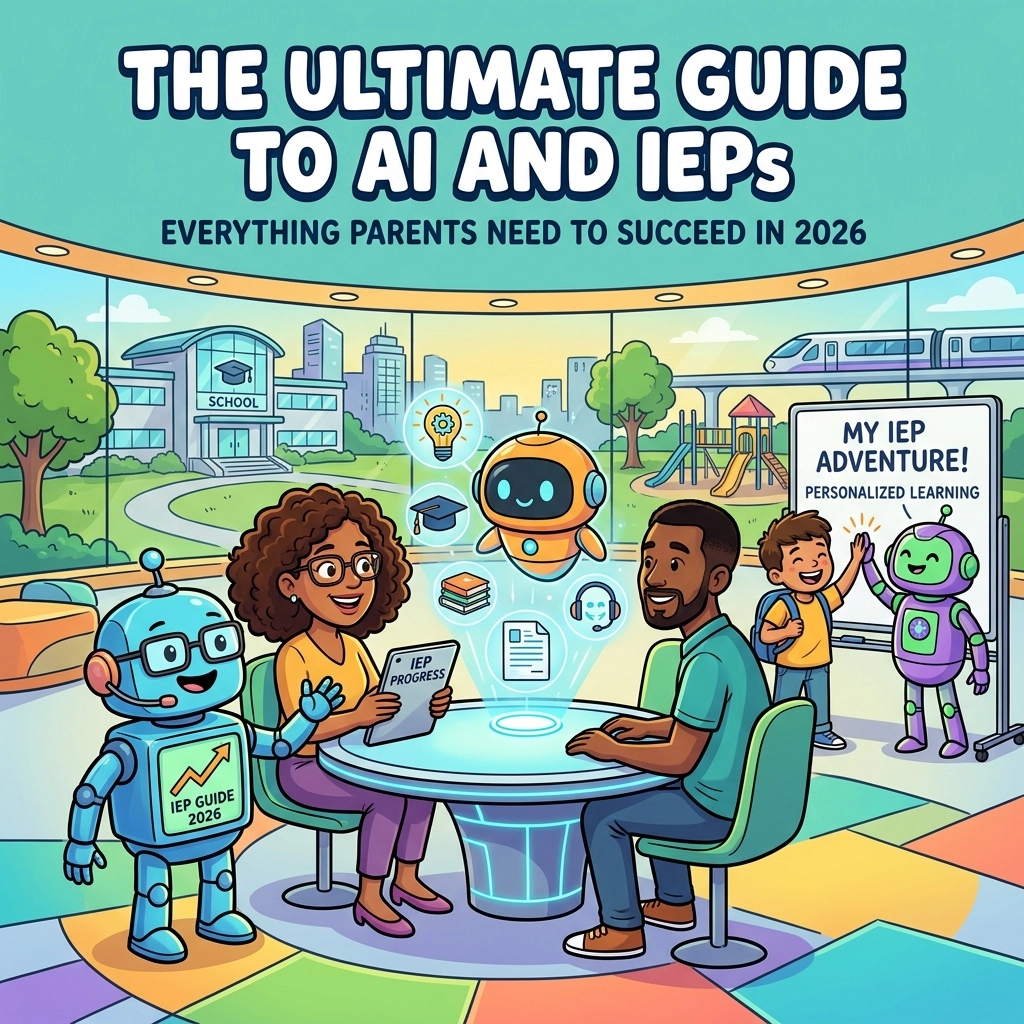
If you have ever sat at a tiny library table surrounded by five educators, three therapists, and a stack of paperwork thick enough to stop a moving train, you know the "IEP Fog." It’s that moment in an Individualized Education Program (the legal roadmap for your child's special education services) meeting where the acronyms start flying, FBA, BIP, LRE, OH MY!, and you realize you’re the only person in the room who didn’t get the secret decoder ring. For years, parents have felt like they were swimming upstream in a swamp of jargon, trying to advocate for their child’s needs while drowning in data they didn't fully understand.
But it’s March 2026, and the tide is turning.
Down here in the Friendly Ferns Swamp, we have a friend named Byte. Byte is a tech-savvy alligator who wears a tiny pair of blue-light glasses and carries a solar-powered tablet. He’s what we call an "early adopter." While the other gators are busy sunning themselves on logs, Byte is busy using Artificial Intelligence (AI) to organize the swamp’s annual "Lily Pad Literacy" program. Byte knows a secret: AI isn't a scary robot from a movie; it’s a pair of high-powered binoculars that helps you see through the thickest swamp mist.
"I used to spend weeks trying to figure out if the minnows were actually learning to swim faster," Byte says, tapping his screen. "Now, I just feed the data into my assistant, and it tells me exactly where the snags are. It’s not doing the work for me, it’s just making me a better Gator-Boss."
From Paperwork Piles to Actionable Insights: Organizing the "Swamp of Data"
The first hurdle every parent faces is the sheer volume of "stuff." Progress reports, private evaluations, teacher emails, and past IEPs. In 2026, AI tools like Penny are helping parents move from "Awareness to Engagement" by acting as digital filing cabinets that actually think.
When you upload a 40-page neuropsychological evaluation into an AI tool, you aren't just storing it. You are "vectorizing" it (breaking down complex text into mathematical patterns that a computer can search instantly). You can ask the AI: "Summarize my child’s top three executive functioning deficits based on this report." Within seconds, the "Swamp of Data" becomes a clear map.
"The emotional weight of an IEP is heavy enough without the physical weight of a three-ring binder," says Dr. Elena Rodriguez, a Special Education Consultant. "When parents use AI to organize their child's history, they show up to the meeting with confidence. They aren't searching for page 12; they are citing specific trends in reading comprehension from the last three years."
The XTERMIGATOR KIDS mission is to remind everyone that a disability is not an inability, and tech is the tool that proves it.
Decoding the "Edu-Speak": Simplifying Complex School Reports
Let’s be honest: school reports are often written in a dialect of English that is only spoken by administrators and very specific types of owls. Phrases like "demonstrates difficulty with phonological processing in the absence of visual cues" can be a lot to digest when you're just trying to find out if your kid is okay.
In 2026, the playing field is being leveled. Parents are now using "Generative AI" (AI that can create or summarize text) to translate these reports into "Human Speak."
“I used to nod my head in meetings even when I was totally lost,” shares Marcus, a father of a 10-year-old with ADHD. “Now, I take the draft IEP the school sends me, run it through my AI assistant, and ask it to explain the ‘Goals’ section to me like I’m a fifth-grader. Suddenly, I’m not just a bystander; I’m an active participant. I realized one of the goals was actually written for a much younger child, and I was able to catch it before the meeting even started.”
By using AI to simplify language, parents can focus on the heart of the matter: their child. If you're feeling stuck, you can always check our FAQ for more ways to bridge the communication gap between home and school.
The "Voice of the Swamp": Finding Your Advocacy Scripts
The most intimidating part of any IEP meeting is the "Parent Input" section. It’s your chance to speak up, but the pressure can make your mind go blank. This is where Byte’s favorite trick comes in: Advocacy Scripting.
AI tools can help you draft professional, firm, and collaborative emails or speaking points. For example, you might prompt an AI with: "My child’s teacher says they don't need a 1:1 aide, but my child is eloping from the classroom twice a week. Write a polite but firm request for a Functional Behavioral Assessment (FBA)."
The AI provides a template that includes the necessary legal language (IDEA compliance) while maintaining a respectful tone. This "scripting" reduces the emotional "friction" that often leads to conflict between parents and schools. It ensures that the focus stays on the child's legal rights and educational needs.

Visualizing the transformation from a stressed parent with piles of paper to a calm, tech-empowered advocate at a conference table.
Is It Fair? The Ethics and Compliance of AI in Special Ed
According to research from 2025 and 2026, nearly 60% of special education teachers are now using AI to help develop IEPs. This is a game-changer for teacher burnout, saving educators up to six weeks of paperwork time per year! However, as a parent, you need to ensure that the "Individualized" part of the IEP doesn't get lost in the "Artificial."
"AI should support and enhance teacher decision-making, not replace educator judgment," notes the latest 2026 Special Education Policy Brief. While AI can identify patterns (like a student’s progress in math over six months), the human teacher must still be the one to decide why those patterns are happening.
When you sit down at that meeting, don't be afraid to ask:
- "Which AI tools did the district use to help draft these goals?"
- "How are you ensuring my child’s private data stays secure?"
- "Can we review the data patterns the AI identified together?"
Remember, the goal is "Inclusive Education." We want our kids in the "Friendly Ferns Swamp" with everyone else, and tech is the bridge that gets them there. If you want to dive deeper into these topics with other parents, join our Community Connection to share your tech wins and worries.
Emotional Breakthroughs: When the Tech Meets the Heart
The most beautiful thing about the AI revolution in 2026 isn't the software: it's the shift in the parent-child relationship. When a parent isn't spending four hours a night deciphering a 504 plan or an IEP, they have four more hours to spend reading stories or playing in the backyard.
"I had a breakthrough moment," says Sarah, a mother who uses the XTERMIGATOR KIDS approach. "I was so busy being an 'Admin Mom' that I forgot to be just 'Mom.' The AI took over the admin side: the sorting, the summarizing, the scheduling. For the first time in years, I went into an IEP meeting feeling like a partner, not an adversary. I cried after the meeting, not because it was hard, but because it was finally easy."

Different is beautiful, and when we use the right tools, we become unstoppable together.
Forward-Looking Aspirations: The Future of the "Digital IEP"
As we look toward the rest of 2026 and beyond, the dream is a "Living IEP": a digital, real-time dashboard where parents, teachers, and students can see progress as it happens, powered by AI that suggests adjustments in real-time. We are moving away from the "Once-a-Year-Meeting" and toward a "Daily-Support-System."
Byte the Gator is already working on his next project: a voice-activated sensory guide for classrooms. But until then, he wants every parent to know that they have the power of a thousand researchers right in their pocket.
Don't let the paperwork scare you. Whether you are browsing our Books to find stories that represent your child’s journey or you are logging into your Member Dashboard to access new resources, remember that you are your child’s best advocate.
The swamp might be thick, and the mist might be heavy, but with a little bit of tech and a whole lot of heart, you’ve got this.
Interested in bringing more inclusion to your school or home? Check out our Shop for gear that celebrates neurodiversity and the "Xtermigator" spirit!
The stories we tell matter. Let's write a new story for special education: one where every parent is empowered and every child is seen.