
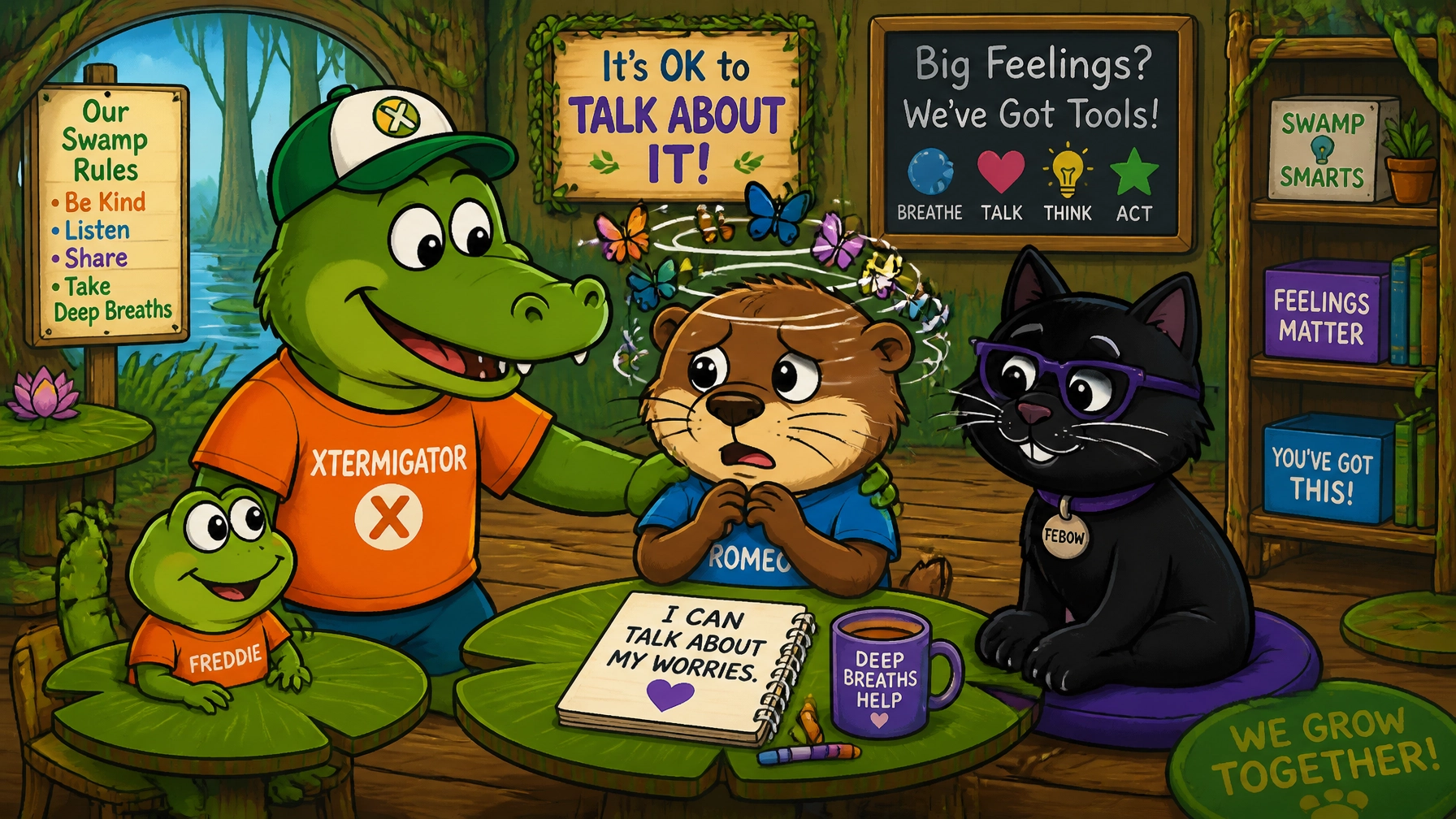
It starts with a stomach ache on Monday morning. Then, it’s the "Sunday Scaries" that keep them awake at night. By the time they reach the classroom door, the "butterflies" in their belly have turned into a full-blown swarm. For many children: especially those navigating neurodiversity like ADHD, autism, or learning differences: the classroom can feel less like a place of discovery and more like a high-stakes obstacle course.
If you’ve ever watched a child "shut down" during a math test or seen a student’s "disruptive behavior" escalate when a substitute teacher walks in, you aren’t just seeing a "naughty kid." You are witnessing the unseen weight of anxiety.
At XTERMIGATOR KIDS, we believe that understanding these unseen challenges is the first step toward transformation. As our founder, Eric Fishon, often says, "A disability is not an inability: it’s your greatest superpower." But to unlock that superpower, we have to clear the fog of anxiety first.
Recognizing the "Swamp Fog": Identifying Anxiety in the Classroom
Anxiety doesn't always look like a shaking hand or a tearful goodbye. In a busy classroom, it often masks itself as something else entirely. Educators and parents need to put on their "Investigator’s Lens": just like Xtermigator: to see what’s really going on beneath the surface.
- Avoidance and Procrastination: A student who constantly asks to go to the nurse or takes "forever" to start a task might be paralyzed by the fear of making a mistake (perfectionism).
- Irritability and "Defiance": When the brain’s "fight or flight" system (the amygdala) is triggered, a child may push back against instructions. This is often a survival response to feeling overwhelmed, not a lack of respect.
- Physical Symptoms: Headaches, stomach aches, and fatigue are real physical manifestations of Generalized Anxiety Disorder (GAD) and school-based stress.
- Sensory Overload: For neurodivergent children, the hum of a fluorescent light or the scraping of chairs can be the "spark" that sets off an anxiety flare-up.
"When we look at a child’s behavior through the lens of anxiety rather than compliance, everything changes," notes one veteran inclusion specialist. "We stop asking 'Why won't they?' and start asking 'How can we help them feel safe?'"
The Friendly Ferns Strategy: Building a "Safe Harbor" in the Classroom
In our stories at Friendly Ferns Swamp, our characters often face big feelings. Romeo the otter might feel a bit overwhelmed by the noise, while Freddie the frog might need to move to stay regulated. Teachers can use these same principles to create an inclusive environment.
1. Establish Predictable Routines (The "Map of the Swamp")
Uncertainty is the fuel that feeds anxiety. When kids know exactly what is coming next, their brains can move out of "high alert" mode.
- Visual Schedules: Post a clear, illustrated daily schedule. Use "First/Then" boards for students who struggle with transitions.
- Transition Warnings: Give five-minute and one-minute warnings before switching activities.
- The "No-Surprise" Rule: If there is a change (like a fire drill or a guest speaker), let anxious students know as early as possible.
2. Create a "Calm Corner"
Every classroom needs a space where a student can go to "de-swamp" their brain. This isn't a "time-out" spot: it's a regulation station.
- Sensory Tools: Include noise-canceling headphones, fidget spinners, and weighted lap pads.
- Visual Aids: Post a "Breathing with Freddie" chart showing deep-breathing exercises.
- A "Safe Place" Visualization: Help students imagine a peaceful spot in the Friendly Ferns Swamp where they feel completely protected.

Tebow the Cat (pictured above) is an expert at "observational calm." He reminds us that sometimes, the best way to handle a big feeling is to sit quietly and watch the stars.
3. Implement Cognitive Reframing
(Cognitive reframing is the practice of identifying and challenging unhelpful thoughts to change the way we feel.) Teachers can model this by saying, "I can see this math problem is feeling like a giant swamp monster right now. Let’s break it into three small lily pads we can hop across instead."
Home-to-School Harmony: Practical Tips for Parents
The transition from home to school is often the hardest part of the day. Parents can act as the "Grounding Anchor" for their children by implementing a few key strategies.
The "Superpower" Morning Routine
A chaotic morning sets the stage for a high-anxiety day.
- Use Tools for Organization: We highly recommend tools like the Cozyla Digital Calendar to help children visualize their day before it even begins.
- Validate, Don't Dismiss: Instead of saying "Don't worry, you'll be fine," try: "I can see you're feeling nervous about the spelling test. That makes sense. What's one thing we can do to make the 'butterflies' feel a little smaller?" (This validates their emotional experience while moving toward a solution.)
Collaborative Communication
You and the teacher are on the same team. Share what works at home! If your child finds comfort in Tebow’s "calm strength," let the teacher know that "Tebow breaks" are a great regulation tool.
"The most successful interventions I’ve seen," says Dr. Fishon, "are when parents and teachers stop looking at the child as a 'problem to be fixed' and start looking at the environment as a 'space to be adjusted.' When the environment fits the child, the anxiety begins to lift."
Turning Anxiety Into a Superpower
It might sound counterintuitive, but anxiety often comes with hidden strengths. Children with anxiety are often:
- Highly Observant: Like Tebow, they notice details others miss.
- Empathetic: Because they feel deeply, they are often the first to notice when a friend is hurt.
- Careful Planners: Their desire to be prepared makes them excellent strategists when given the right tools.
At XTERMIGATOR KIDS, our goal is to help every child see that their "unseen disability" is actually a unique way of processing the world.

Different is beautiful. Together, we are unstoppable. (The Friendly Ferns crew celebrating inclusion at the Swamp.)
Looking Forward: A Future of Inclusion
As we move forward, we hope to see every classroom become a place where neurodiversity is celebrated, not just "managed." We are constantly developing new resources: from our "Xtermigator & The Zoomy Frog" books to interactive workshops: to bridge the gap between education and empathy.
If you are a parent or teacher navigating this journey, remember: you don't have to do it alone. The swamp is a big place, but we have the maps and the crew to help you find your way. Let's keep working together to turn those "worries" into "wonders."
Looking for more ways to support your neurodiverse learner? Check out our Neurodiversity 101 Guide or explore our collection of coloring pages and worksheets to bring the Friendly Ferns Swamp home today!