
"He’s just not applying himself." "She’s so bright, if only she’d stop daydreaming." "They are being intentionally defiant." If you are a parent or teacher of a child with an invisible disability, these phrases probably feel like a weighted backpack you can’t take off. The biggest hurdle for kids with neurodivergence isn't the disability itself: it’s the fact that no one can see it.
In the hallways of a typical school, we recognize a wheelchair or a white cane immediately. But we don't always see the "internal traffic jam" of ADHD, the "sensory static" of autism, or the "silent siren" of anxiety. Because these challenges are hidden, children are often mislabeled as lazy, unmotivated, or "difficult."
At XTERMIGATOR KIDS, we believe that understanding is the first step toward transformation. As our founder, Eric Fishon, often says: "A disability is not an inability: it is your greatest superpower. We just need to give kids the right cape and the right map to fly."
Beyond the Surface: Why Recognition is the First Step to Inclusion
An invisible disability (a condition that significantly affects learning, behavior, or participation but is not immediately obvious in a student’s appearance) can feel like navigating a swamp without a flashlight. When a child’s brain processes information differently, the standard classroom environment can feel like a series of obstacles rather than a place of growth.
According to 2026 educational trends, nearly 15% of all public school students are now served under special education law, with the largest groups being those with specific learning disabilities and "other health impairments" like ADHD. This isn't just a "small group" issue; it’s a classroom-wide reality.
"When we stopped looking at my son's 'behavior' and started looking at his 'processing,' everything changed," shared Sarah, a mother who uses our inclusive educational services. "He wasn't trying to be bad; he was just trying to survive a room that felt too loud and a schedule that felt too fast."
Meet the Swamp Stars: Making Neurodiversity Relatable through Storytelling
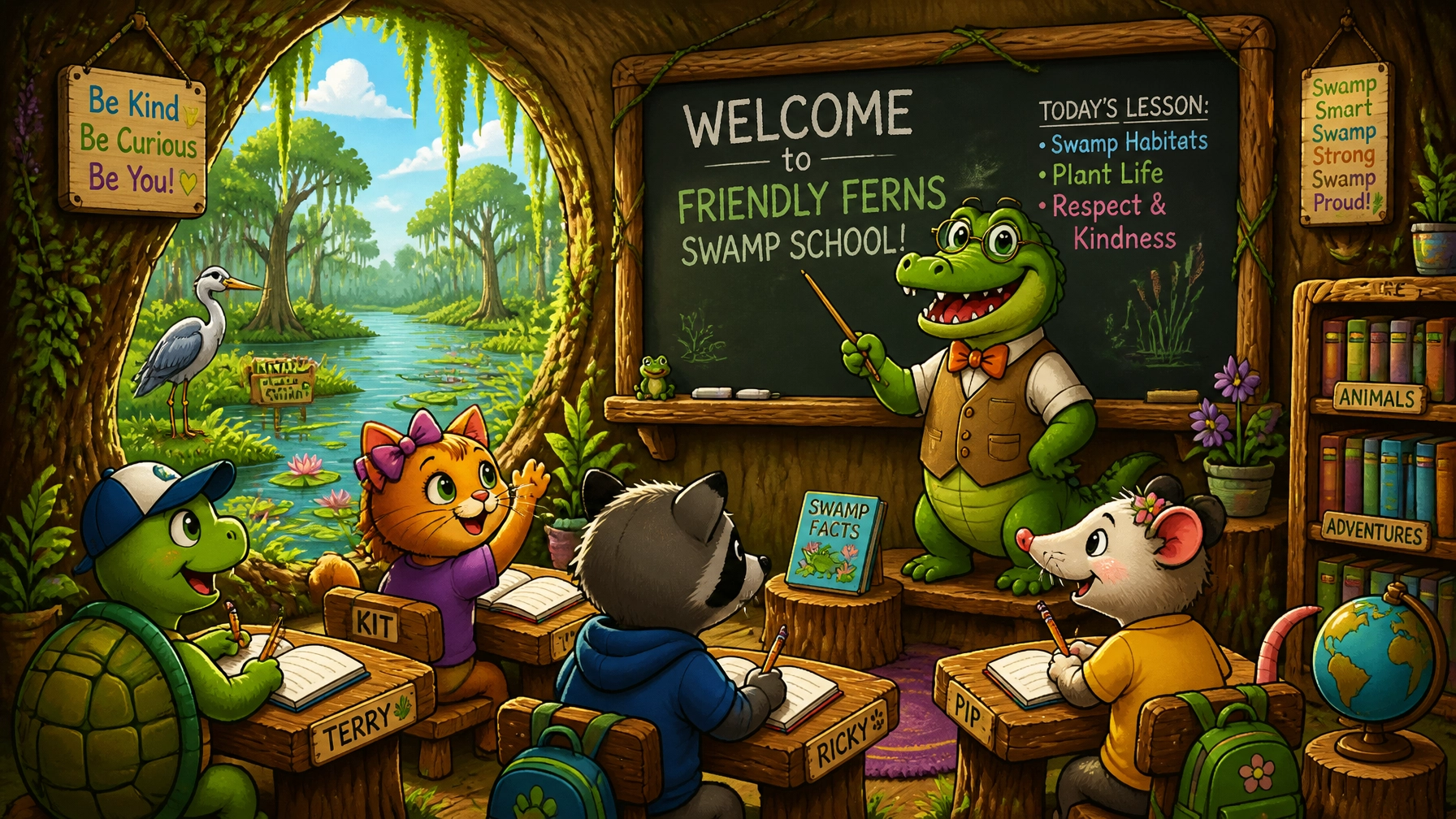
To help children and educators understand these complex concepts, we use the characters of Friendly Ferns Swamp. Each character reflects a different way of experiencing the world, turning a "diagnosis" into a relatable "superpower."
- Freddie the Alligator: Freddie has a "Big Heart" and a brain that moves at 100 miles per hour. He represents the ADHD experience: full of energy and creativity, but sometimes struggling to stay on the lily pad. (You can find Freddie’s coloring page here to start the conversation with your students.)
- Shelly the Turtle: Shelly is calm and patient, but she needs a little more time to process things. She represents those with learning differences or sensory processing needs. She reminds us that "slow and steady" isn't just a race strategy: it’s a valid way to learn. (Check out Shelly’s character intro worksheet for parent tips on patience.)
- Tebow the Cat: Tebow is observant and loyal, but he can get overwhelmed by too much noise or change. He reflects the autistic experience, showing us that being "different" is just another way of being "cool."


The lightbulb moment: when a child realizes their brain's unique wiring is an asset, not a flaw.
Navigating the Map: The Power of IEPs and 504 Plans
For many families, the journey starts with a formal document. Whether it’s an IEP (Individualized Education Program) or a 504 Plan (a plan developed to ensure that a child who has a disability identified under the law receives accommodations that will ensure their academic success), these tools are the legal "maps" for your child’s education.
Common accommodations for invisible disabilities include:
- Preferential Seating: Sitting away from the buzzing pencil sharpener or the high-traffic doorway.
- Extended Time: Allowing the brain time to "download" information without the pressure of a ticking clock.
- Visual Schedules: Using pictures or digital tools to show what’s coming next, reducing the "unknown" that triggers anxiety.
But these plans are only as good as the partnership behind them. "The most successful students are those where the parents and teachers are on the same team," says Dr. Eric Fishon. "It’s not about 'us vs. them'; it’s about 'all of us for the child.'"
Tools for the Modern Swamp: Organization and Emotional Regulation
In 2026, technology has become a vital ally for neurodivergent kids. One of the biggest challenges for kids with ADHD or executive function disorder (a set of mental skills that include working memory, flexible thinking, and self-control) is keeping track of time and tasks.
This is where tools like the Cozyla Digital Calendar come into play. Instead of a messy paper planner that gets lost in the bottom of a backpack, a digital calendar provides a central, visual "command center" for the whole family. It transforms the morning "Get your shoes on!" chaos into a predictable routine.

Visual cues are a lifeline for children who struggle with executive functioning and time management.
Creating an Inclusive Classroom: The Swamp Adventure Method
Teachers, you don't need a PhD in special education to make your classroom inclusive. Often, the top neurodivergent-friendly strategies are those that benefit every child.
- Predictable Structure: Post a visual schedule and stick to it.
- Sensory Breaks: Allow a "quiet corner" or a "swamp stomp" (a quick movement break) to reset the nervous system.
- Flexible Participation: Some kids can’t speak up in front of a group but can write a brilliant response or record a video.
By turning your classroom into an Inclusive Swamp Adventure, you are telling every child that they belong. You are moving from "accommodating" a disability to "celebrating" a diverse community.
Emotional Transformation: From "I Can't" to "I Can, Differently"
The most beautiful moment in our work is the "Emotional Transformation." It’s that second when a child who has been told they are "broken" realizes they are actually "built differently."
One teacher recently wrote to us about a student using our Xtermigator Big Heart series: "One of my students with dyslexia always felt 'stupid' during reading time. After reading about Freddie and how his brain works like a race car, he looked at me and said, 'My brain isn't slow, it just takes the scenic route.' He started participating again. That’s the power of the right story."

Inclusion means everyone has a seat at the table, regardless of how their brain processes the world.
Forward-Looking Aspirations: The Future is Neuro-Inclusive
As we look toward the future, we hope to see a world where the term "invisible disability" is no longer synonymous with "invisible needs." We envision schools where Universal Design for Learning (an educational framework based on research in the learning sciences) is the standard, not the exception.
We are working toward a day when every teacher has the resources they need, and every parent feels supported, not exhausted. We want Friendly Ferns Swamp to be more than just a story: we want it to be a blueprint for a kinder, braver, and more authentic world.
Remember, whether you are a parent, a teacher, or a child: Different is beautiful. Together, we are unstoppable.
Ready to start your inclusion journey?
- Download our free parent resources to navigate the school year.
- Explore our Inclusive Classroom Swamp Adventure for your school.
- Join the conversation on social media and share your "Superpower" story with the tag #XtermigatorKids.
